Old White Jewish Men

Last Friday afternoon, B’nai Brith Canada sent out a news release. They do this often. Stuff happens in the Jewish community, and they send out a news release. Stuff happens in the Christian community, and they send out a news release. Someone farts at York University, and they send out a news release. While the many emails from “JEWISH CANADA” can become annoying at times, I ultimately commend them for remaining diligent in their communication efforts – they do a much better job than many other Jewish organizations.

But. Last Friday’s email was different. The title was:

United Church of Canada Resolutions Insult to Grassroots Canadian Jews

Hmm. Something jumped out at me. Angered me a little. Can you spot it? Moving on, the first sentence in the email read as follows:

B’nai Brith Canada, the voice of the grassroots Canadian Jewish community, was disappointed to learn that resolutions that enable United Church Conferences, Presbyteries, congregations, and community ministries to boycott the Jewish State of Israel, if they so choose, were unanimously passed at the United Church of Canada’s (UCC) 40th General Council.

How about now?

B’nai Brith is many things. They’re a Jewish advocacy organization. They’re an Israel advocacy organization. They’re a human rights advocacy organization. Their newspaper in Canada claims to provide “the real story – and the story behind the story – from a Jewish perspective,” though more often than not, that appears to be code for the Right Wing perspective. I should also say that they run a number of summer camps, and Jewish camping is more than important to me. They are indeed many things, but they are certainly not grassroots.

What is grassroots? For starters, labeling an organization as grassroots implies that there is a movement behind the organization. It implies that a collection of people – the roots – have come together independently to identify as a group with a shared philosophy. What is the B’nai Brith movement? Visit the “About Us” section of the website, and you’ll learn that:

B’nai Brith Canada is the action arm of the Jewish community. We believe in:

1. Reaching out to those in need
2. Fighting antisemitism, racism and bigotry;
3. Promoting human rights and peace throughout the world.

What is B’nai Brith’s philosophy? Their ideology? Their social perspective? These are things we would expect to know about a movement. How many people today will claim that they are part of the B’nai Brith movement?

The term also implies that the movement and its related organizations evolved spontaneously and naturally as a response to some stimulus. B’nai Brith – at least in the USA – certainly had a grassroots origin, with German-Jewish immigrants gathering to do something about the squalor in which Jews were living at the time. But now they have evolved into something beyond this grassroots origin. They do wonderful work, representing their constituents and advocating on behalf of certain Jewish views, but they are far past the days of being a small, grassroots movement. To be sure, they are part and parcel of the Jewish establishment. Meet your friends Federation, the World Zionist Organization, the Jewish Agency, and the State of Israel.

Labeling a group grassroots is also a way to highlight the differences between that group and its accompanying movement, and other organizations governed by more traditional power structures. A quick glance at B’nai Brith and B’nai Brith Canada’s websites is more than enough to show you that they are intimately familiar with “traditional power structures,” as the names and pictures of their leadership look like they came from a Facebook group called “old white Jewish men.”

The labeling of B’nai Brith Canada as grassroots is a curious move by the organization. For one, it is an abrupt change – they’ve never called themselves this before. Last Friday’s email was the first appearance of this adjective. Why, all of a sudden the need to add this term in August 2009? (8.28.09 Update: Turns out they have called their constituency grassroots a few times before. Mostly in press releases.)

I take great issue with this. It’s an attempt to make it look like they aren’t facing declining relevance like the rest of the organizational Jewish world. It’s an attempt to make it look like they don’t have a member base that’s almost entirely made up of people who were born before 1950 (not that there’s anything wrong with people born before the invention of the VW minibus). It’s an attempt to make it look like they attract the same type of people that Obama attracts.

There’s a term for what B’nai Brith is doing. It’s called Astroturfing. And in the political, advertising, and PR world, this is a BIG no-no. By calling themselves grassroots, B’nai Brith Canada is trying to project an image of something it isn’t.

Let me re-iterate: B’nai Brith does many wonderful things, many vital things for the Jewish and broader communities in Canada and the US. But they are not grassroots. To try and present this image is dishonest and unfair.

I’m also left with a few final questions from B’nai Brith’s email of last Friday…

Is there a difference between “grassroots” Canadian Jews and “regular” Canadian Jews? And if so, is the Canadian Jewish community insulted and disappointed en masse, or is just the “grassroots” Jews? And if so, is B’nai Brith really the voice of the entire “grassroots” Canadian community?

This is where B’nai Brith shows their true colours. You can’t just blanket label a group of people as grassroots. At the end of the day, I’m left wondering what B’nai Brith Canada’s “grassroots” movement is all about…
Identity Politics

Where was the Toronto Star three months ago, when I needed them to back me up? Now, after facing a small amount of backlash for my repeated arguments that the Conservative Party of Canada was able to win in my riding of Thornhill by attracting the votes of Jews who would vote for whichever party looked like they supported Israel more, Thomas Walkom – National Affairs Collumnist – has penned an article on ethnic voting and identity politics that backs up the very arguments I postited. Here’s an excerpt:

…In a world where no single party can command a majority of MPs, individual ridings become even more significant. And among some voters in some ridings, support for Israel is a make-or-break issue… Identity politics predates Confederation… In ridings where there is a significant Jewish population, this matters. Kent, for instance, may back Israel as a matter of deeply held principle. But if he did not, this might well hurt him in Thornhill, a riding that he narrowly won last year…

While this is pretty much a closed issue that I hadn’t intended on revisiting, the situation in the Israel and Gaza has brought it to light again. So thanks, Thomas. I couldn’t agree with you more!

Extra Terrestrial

I had an encounter at the airport coming back to Toronto on Wednesday. For those of you familiar with my travel history, this should come as no surprise to you. I travel a lot, and as a result, I often have lots of stories to share. These stories are often delightfully fun for the listener, yet traumatic for the protagonist (me). They range from being interrogated in “the room” at the airport, to being told that the airplane “needs to be control, alt, deleted.”

Wednesday’s story was slightly different. No interrogation room, and no technical worries.

As I was going through customs in Toronto, I handed in my immigration form. On it, I had listed my home address as my home address here in Toronto – my parents’ house. This is the house I grew up in, the house where I “reside” when not in New York, and the house where I currently have a bed. It’s still home. Every time I’ve crossed the border, I’ve always listed it as my permanent residence. Seeing as my time living in New York has an explicit expiry date stamped in my passport (October 2011 I get kicked out of the USA!), New York certainly can’t be my permanent residence (although, I wouldn’t complain if it were.)

So I handed in my immigration form. Here’s the encounter that followed:

Canadian Border and Customs Agent (CBSA): “Were are you coming from, sir?”

Me: “New York.”

CBSA: “What do you do there, sir?”

Me: “I work there.”

At this point I was prepared to launch into the longwinded explanation of what I do, why it has to be done in New York, what exactly Jewish Camp is, and what the hell the Union for Reform Judaism is. I’m used it . But that didn’t happen.

CBSA: “So why did you list this address in Thornhill as your home address?”

Me: “Because that’s my home address. I’m a non-resident alien in the United States. I live there, but I don’t permanently reside there.”

CBSA: “Well that’s fine and dandy, but you don’t reside in Canada either, so you can’t list that as your home address.”

Me: “Pardon?”

CBSA: “You don’t reside in Canada. You can’t list yourself as a resident of Canada when you don’t reside here. This isn’t your permanent address.”

Me: “But when I cross in to the US, they don’t let me list my New York address as my permanent address, either… So where do I live?”

CBSA: “You’ll have to figure that out on your own. For now, I’m stamping you as a visitor to Canada.”

Me: “But I’m a citizen! I have a passport and a house in Thornhill!”

CBSA: “You don’t live there. You don’t have residency in Canada.”

Me: “Well shit.”

And with that encounter, apparently I became a drifter. An alien in the US, and a visitor to Canada. Although this seems humourous on the surface, I’m actually slightly troubled by this loophole. It creates a sub-status of individuals somewhere in between refugees and political deserters, and I am neither of those.

So here I am, an alien. Awesome.

I’m just saying, is all…

canadiantire1Remember during the past few weeks of political turmoil when Stephen Harper repeatedly insisted that what Canada really, really needed during “the most difficult global economic crisis in many decades” was stability — a stability only Harper’s Conservative government could provide?
Yeah, I remember that, too.

My how times have quickly changed, haven’t they Mr. Harper? Maybe I should be a little more sympathetic… I guess it’s pretty hard working to stabilize our country from the front seat of the roller coaster ride you’re leading Canada on.

After all, the zigzaging, pessimism, and uncertain depression might just be the side-effects of riding on this coaster.

Except these aren’t side-effects… they’re effects. I’m a flat-out dunce when it comes to math and money, but even I can see that Harper’s not exactly cultivating a sense of economic stability. Because I’m a little dyslexic when it comes to the math side of economy, I’ll refer you to some brilliantly damning words from Doug McArthur:

[the current goings on is an] indication of really how kind of badly organized they are right now. It’s funny that a government who has prided itself — at least so they say on controlling the message and keeping the message controlled out of Prime Minister’s office — has perhaps done worse than any other government I can remember in terms of messaging about the state of the economy and I think this is bad for the economy. I think to have inconsistent messages, constantly changing messages, an apparent failure to understand what’s going on in the economy with that is a bad thing in terms of the overall all the actors in the economy.

If you need a good primer on why Harper is an impediment to stability and democratic clarity, I highly suggest you check out the full article at the Globe. It’s worth it.

Is there a Doctor in the House?

Do the Conservatives pledge a hypocritic oath when they take office? You might assume so, given this juicy item emerging from the dark pages of parliamentry history…

“Bloc part of secret coalition plot in 2000 with Canadian Alliance”

You might also assume that they take such an oath given what Harper had the gall to say yesterday. These were his words:

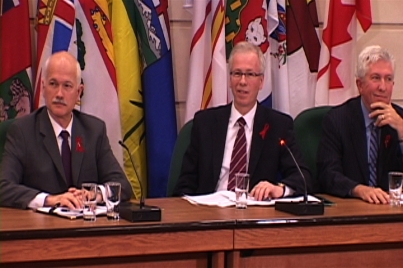
presser-62“Mr. Speaker, yesterday, as part of the culmination of the machinations of the leader of the NDP, we had these three parties together forming this agreement, signing a document, and they would not even have the Canadian flag behind them. They had to be photographed without it.

They had to be photographed without it because a member of their coalition does not even believe in the country. As Prime Minister it is not my responsibility to turn the keys of power over to a group like that.”

Those are his words. And how about that picture? Well that would be the photograph that Mr. Harper was referring to. See those things in the background? Yup. Flags. Canadian flags. Provincial flags, too.

It’s actually amazing that we can interpret anything the Tories are saying these days, given that they’ve taken to new stretches of doublespeak. The CPC is now saying one thing in English to the Anglos, and a diametrically opposite thing in French to the Francos. Do they think that there aren’t those of us who are bilingual? That line of thought would fall in line with their black and white view of the world, though.

To round off today’s vomit-inducing news, I prescribe reading the Toronto Star’s Q&A’s about Coalition governments. Here’s an excerpt of extreme importance to my fellow (temporary) ex-pats:

Is this a coup d’état?
That’s the way the Harper government would like to portray it. But it’s fundamentally confusing a Republican system with a Parliamentary system. In essence, we have an indirect election of government – rather than a direct election. In a Republican system, voters in the U.S. got to decide, `Do I want McCain or Obama.’ And then secondarily: `Who do I want as my local rep or my state rep?’ Whereas in the Canadian parliamentary system, like the British parliamentary system, you only get to vote for whoever your local rep is, and then the majority of members of that legislature then get to decide who forms that government. And they’re free to change their minds over the course of a parliament…

Until tomorrow night…

It’s Demo-crazy!

bron1180lMy, my, my how things have changed up North. There are indeed moments when I long to be back in Canada. This is one of them. Things are heating up in the true north strong and free, although I imagine that Stephen Harper would argue that things are a little too strong and too free for his liking.

In case you’re living under a rock (read: If you’re an American and don’t get any news beyond the borders of your country), you can enjoy a sampling of Canadian news here, here, here, and here.

I imagine that I’ll have much to say over the next week as this coalition comes to fruition and our “strengthened” government (Stephen Harper’s words) collapses. What I’d like to focus on is not the news itself… there are enough people getting paid to rant and rave about all that. Instead, I’ll direct my own rants at the inevitable hypocrisy that will emerge from the Conservative camp as they attempt to quash any attempt at upholding the notion of checks and balances in our parliament.

To get the ball rolling, let’s put to rest a few of the lies that have already emerged from the Conservative party:

LIE: The coalition is an “undemocratic,” attempt at seizing “unearned” power.

TRUTH: If the ruling party in parliament loses its majority support in the House of Commons, the Governor General will either call for a new election, or if the viable option exists for a coalition government to be formed, can allow them the opportunity to govern. More on that here, for you non-believers. This is a minority government, folks. It’s constitutional. It’s the very definition of democracy. It’s called checks and balances, people.

LIE:This is a “backroom deal that would usurp the elected government without the people’s consent.”

TRUTH: See above. Also note that anything that happens on the floor of parliament (where the no-confidence motion will take place) is hardly in a “backroom.” And also note that almost everything the Harper government has done has been in the “backrooms” and boardrooms of the country, without the people’s consent. Moreover, both the Grits and the NDP have been undeniably public and transparent with regards to their “deal”. Anyone with access to Google can tell you that.

LIE: “Voters certainly offered no mandate for the Liberals and NDP to form a formal coalition with the separatist Bloc Quebecois”

TRUTH: There is no “formal” coalition with the Bloc. They will receive no seats, no cabinet positions, and no change of status in parliament. They are no more in a formal coalition with the Libs and the NDP than they are with the Conservatives. The Bloc will continue to decide on their own what to support and what not to. If it happens that they disagree with the current Conservative agenda and agree to a progressive coalition between the Liberals and the NDP – that’s hardly a formal coalition.

AND, let us not forget that IF the Bloc were included in a formal coalition – as the Tories suggest – that would negate the Tory statement that they were not offered a mandate. Anyone with a calculator can tell you that the Liberals, NDP, and Bloc hold more seats together than the Tories. Sounds like a mandate to me…

So folks, please remember the following. What is transpiring in the Canadian Parliament is:
1. Legal.
2. Democratic.
3. Representative of the majority of the Canadian electorate.
4. Not a separatist government.

And just to round things off with an additional dose of Conservative propaganda, check out what John Ivison at the National Post has to say about the state of affairs back home:

…the most likely scenario will see Mr. Dion become Prime Minister at the head of an alliance so unholy it would have been burned at the stake for heresy in the Middle Ages.

Ivison’s statement is the definitive representation of the ideological abuse of power that pervades Harper’s Conservative party – anyone who disagrees with Harper’s view of Canada is a heretic who deserves to be consumed by fire. On that note, let me be blunt. If you are a politically and socially conservative person – I have no fight with you. We may disagree on policy, but hopefully we can agree on the foundational principles of Canadian democracy. But Harper and his Tories are trying to run government by their own rules and are trying to shut down anyone who gets in the way. Ivison’s suggestion of an unholy alliance smells as though it were lifted from the pages of the Spanish Inquisition, not a modern Canadian newspaper. Let’s try and move past that, folks.

Until the next juicy tidbit emerges…

“Stephen, the arts is the economy, stupid…”

So says Karl Pruner, president of ACTRA Toronto to PM Stephen Harper. Well said, Karl.

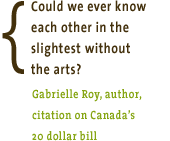
In the midst of Harper’s sniper fire at Canadian Arts and Culture, it is easy to forget that arts and the economy are greatly intertwined. See what I mean here and here and here. And especially here. Or maybe if you want a clear visual of the inseparable ties between the arts and the economy, just whip out your wallet. Find a twenty dollar bill and take a look at the back of it…

Harper and the Conservatives have created a black and white scenario where it’s arts and culture vs. the economy. This is typical conservative polarizing at its worst. But let’s pretend just for a moment that this is actually how life works… The Arts vs. The Economy… What would you choose? Actress Leah Pinsent, has this to say:

“We don’t visit Rome, Japan or Africa to learn about their economies. We go to experience their culture… It is culture, not economics, that truly makes a nation. If we as Canadians are left only with other people’s stories .. then what can we be proud of? There will be nothing left to be proud of…”

The only thing that Pinsent misses is that the arts are part and parcel of the Canadian economy. And yes, the economy should clearly be of paramount importance. But arts and culture – like every other industry – are entitled to be supported by the very government and country that they themselves support. Canadian music and theatre are no more part of a niche industry than the Ford auto plant in Windsor is. Pruner bluntly evokes the question that I’ve been pondering:

“Why is it we talk about investing in the auto sector, investing in the energy sector, and handouts to the arts? Are we tired of this? I think so.”

So while Harper would like you to believe that “ordinary folks don’t care about arts,” (his words) let’s stop pretending that arts and culture aren’t intermingled in the genetic makeup of Canada’s economic infrastructure. Let’s stop pretending that this is a black and white issue and that Harper’s already made the right choice for us. And while we’re at it, let’s stop pretending that there’s such thing as an “ordinary” Canadian. Because there isn’t, anymore than there’s such a definable thing as “Canadian arts” or “the Canadian economy.”

Mr. Harper: Canadian arts, the economy, and Canadians themselves are complex things, not reducible to single lines in a budget as you would have the electorate believe. Try expanding your mind a little.

Penniless for the Arts

An addendum to my previous post on Arts funding in Canada. Lest you think I’m just a raving “artsy” lunatic upset that government “handouts” are being scaled back due to “budget” constraints… look at this August 2008 report from the Conference Board of Canada. The Conference Board is an economic and corporate research organization. They are not a government organization. They are not a lobby group of any sort. They are objective and non-partisan. This is what they have to say:

The Conference Board estimates that the economic footprint of Canada’s culture sector was $84.6 billion in 2007, or 7.4 per cent of Canada’s total real GDP, including direct, indirect, and induced contributions. Culture sector employment exceeded 1.1 million jobs in 2007.

I’m not a numbers guy (remember I failed math), but this is pretty compelling. Arts and culture industries play a vital role in attracting people, business, and investment, and in distinguishing Canada as a dynamic and exciting place to live and work. Apparently these just aren’t issues the Conservative party seem to be concerned about.

Faceless for the Arts

Normally, I’m not one to jump on social cause bandwagons. I find that wristbands, ribbons, buttons, stickers, car magnets, and the such are often really more about making individuals feel good about themselves than enacting real change. If people really wanted to make a difference, they would get out of their cars and use their feet. But today, I joined a group on Facebook called “Faceless.” Along with that, I replaced my profile picture to an icon which states “Faceless for the Arts.” This is all a part of a campaign to protest the rapidly declining support of Canadian arts and culture by the federal government.

Before clicking on the “Join Group” button, I hesitated for a moment, but then realized that Facebook is actually the exact place where this type of protest should take place. It is an ironic paradox that our world has become increasingly interconnected, yet at the expense of actual face-time. One of the greatest realms that has been affected by this paradox is arts and culture. In Canada, our current government has decided that if artists want to connect with people, they should do so without any of the support they have traditionally enjoyed from the government. Arts and culture has become an increasingly isolated enterprise in Canada on the federal level, with a lack of recognition of its importance and centrality in our otherwise banal national identity.

The Conservative Party of Canada has shown a blatant contempt for the vitality of Canadian arts and culture. In two and a half years, the Conservative Government has eliminated over $34 Million in funding from Cultural and Heritage Granting Programs. The programs affected were designed to assist artists, arts institutions and not for profit charitable organizations in the creation, development, promotion and dissemination of Canadian art both nationally and internationally. And more cuts are anticipated in the coming weeks as part of Harper’s campaign.

So I joined a Facebook group and changed my picture. Sure, on its own, this measure is not going to make a concrete difference, it’s a symbol. But coupled with a thoughtful vote against the Conservatives in the upcoming elections, it’s more than just a symbol.

I hope and pray that people realize how serious these cuts are, and how they are part of a greater negative ideology on the part of the Conservatives. Things are changing in Canada, and the worst part is it’s not just about how we see ourselves. Just read what Slate has to say about us, in an article titled “What’s the Matter with Canada?”:

…Canada’s political system is in turmoil. Since 2004, a succession of unstable minority governments has led to a constant campaign frenzy, brutalizing Canada’s once-broad political consensus and producing a series of policies at odds with the country’s socially liberal, fiscally conservative identity. Canada is quietly becoming a political basket case, and this latest election may make things even worse.

Make no mistake, these policy changes and funding cuts are radically changing Canadian society.

Seething in an Apathy of Olympic Proportions

We’re getting closer to the start of the Olympics. Which means we’re getting closer to the start of my self-imposed boycott of anything Olympic-related. Here’s a rundown of what I’m (not) doing:

I won’t be watching the games or any of the related ceremonies.

I won’t be purchasing or using products/services from any of the Olympic sponsors.

I won’t be taking joy in Canadian or Israeli medal wins… as unlikely as they may be.

Why all this? This is no empty-threat, hippie bandwaggon protest of anything China-related. I have spent a lot of time thinking about the significance of how we personally relate to something like the Olympics, and I believe that corporations, governments, some celebrities, and a very select group of organizations can affect a tangible change. Outside of that, very few individuals can look forward to making a noticable difference. So I admit that my personal boycott isn’t going to have worldwide ripples. Even as part of larger boycotts, these protests won’t have the necessary politcal ramifications that I wish they could have. There’s just too much worlwide tether to China, and people don’t seem to want to bite the hand that feeds them… no matter how tainted the food is.

But I don’t eat foods that I think will disagree with my body, and I’m not going to injest any part of these games. I’m no apathetic cynic, and I’m not going to resign myself to sit back and let things be the way they are “just because.” I humbly suggest that you don’t either.

Here’s a short recap of why I’m taking a political stance on this one… As I noted a few months ago when I came to this decision, it’s based on a few personal realizations and decisions:

1. The olympics are inherently a political event. To suggest otherwise is nonsense. They were formed out of political motivation, and remain a nationalized institution. To that extent, they merit a political response.

2. It is fair to hold our athletes to a higher standard. I believe that the Canadian olympic team should have withdrawn from these games. By participating, they are making a tacit statement that protesting human rights violations and the neglect of civil, social, political, and labour justices takes a back seat to the advancement of personal goals. It’s just plain egotistical.

3. My tax dollars have gone to fund the Canadian team. This is not where I want my government money going.

Intriguingly, our Prime Minister has decided not to attend the Games, and will be joined in his absence by the British PM and German Chancellor. Also, since being elected in 2006, he hasn’t travelled to China, and has decreased our trading relationship with them. I’m no fan of the Conservatives, but the dude’s got it right.

Among all this talk of boycott, President Bush spoke up from his cave and said that a personal boycott “would be an affront to the Chinese people.” Nu? Isn’t that the point? China’s abuses are an affront to the world; the least we can do is step up in their faces. Props to Harper for at least getting that much into his head.

Outside of my mildly apathetic disdain, you can find a humourous look at these olympics, check out Dawn Ponders, who, among other things, has this to say:

…Let me get this straight – The Olympic Games are supposed to celebrate the best in sport and fitness and two of it’s major sponsors are McDonald’s and Coca Cola? Together, these two companies have added more inches to the waistlines of the world than any designer I can think of.