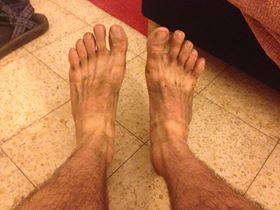
Sure sign of a great campfire… proudly caked with dirt and smoke.

Sure sign of a great campfire… proudly caked with dirt and smoke.

On a winding alleyway in the streets of Jerusalem, that’s the slogan that was emblazoned in blue spray-paint on a wall, just steps from a Orthodox synagogue.
This evening, I went on a Graffiti Tour of Jerusalem, run by T’ruah: The Rabbinic Call for Human Rights. T’ruah is an organization of rabbis from all streams of Judaism that advocates for human rights in Israel and North America. You can learn more about them on their site.
The walking tour this evening brought me face-to-face with much of the graffiti that I’ve often ignored while walking to Burgers Bar or Aroma during my previous stays in Israel. As T’ruah puts it, graffiti culture in Israel “combines humor, politics, poetry, current events, Jewish tradition and more in multiple languages.”
While on previous walks through Jerusalem’s streets, I probably would have just laughed at the iconography of the man squatting to relieve himself, today I gleaned a fascinating new message. The Hebrew word for situation – “matzav” is the word often used to describe the current political state of affairs vis a vis the Occupation and the Israeli-Palestinian conflict.
UPDATE (6.4.2013): An Israeli friend has just informed me that this slogan and the icon of the man pooping are from a Shalom Achshav/Peace Now campaign in support of the 2005 Disengagement from Gaza. See the original graphic here.
We saw a lot of street art on the tour – there will most definitely be a second blog post with more shots. For now, here are some of my favorite pieces of graffiti from our tour:

The image is of Benjamin Netanyahu, the Prime Minister of Israel. In English, the Hebrew text accompanying the image should read: “Those who believe aren’t afraid” – a lyric from an Israeli song by Eyal Golan. But in the word for “aren’t,” one of the letters has been swapped, giving the phrase a new meaning: “Those who believe in him are afraid.” As our tour guide put it, Israeli graffiti is most-often associated with the political left, as the right-wing political establishment is considerably more well funded. So it’s no surprise to see this cheeky poke at the current (right-wing) government showing up in graffiti form.

The red graffiti on the left reads: “Firing Zone 918,” referring to a military firing zone in the southern West Bank. This is a fairly new piece of graffiti that has appeared in Jerusalem; it is a direct response to the Israeli army imposing a test-firing zone on an area where some 1,000 Palestinians live in the South Hebron Hills. This is a very current situation here, with developments taking place as recently as last week. You can read some more about the situation at The Daily Beast. The graffiti – in it’s harsh, militaristic typography – is attempting to draw attention to an aspect of Israeli society that very few Jerusalemites ever consider, let alone see with their own eyes.
In an almost Talmudic-style commentary on the red graffiti, the black writing to its right reads: “War Crimes.” While these were likely left by two separate artists, the relationship between the two is fascinating and creates its own meta-statement on the situation.

While this looks like an artistic variation of an Israeli flag, it’s a deeply provocative piece of art that is itself a “dialogue” between two seemingly oppositional parties. The diagonal white stripes have been painted over the first piece, attempting to cover up the original artist’s intended message. The Jewish Stars beneath the white-washing originally included Hindu “Om” icons, Christian crosses, and Muslim Stars & Crescents. Ostensibly, the original artist intended to present a message of coexistence, which was seemingly anathema to whoever came along and painted over them.
Luckily, as we rounded the corner, we came across an unaltered version of the same piece:

To round things off, it is worth stating that while Israel at large and Jerusalem in particular remain highly charged political environments, not all graffiti is so heavy-handed. Sometimes, someone just comes along and shares a simple, yet easily understandable message; one that may or may not have already been shared by some pretty powerful religious figures 46 years ago:
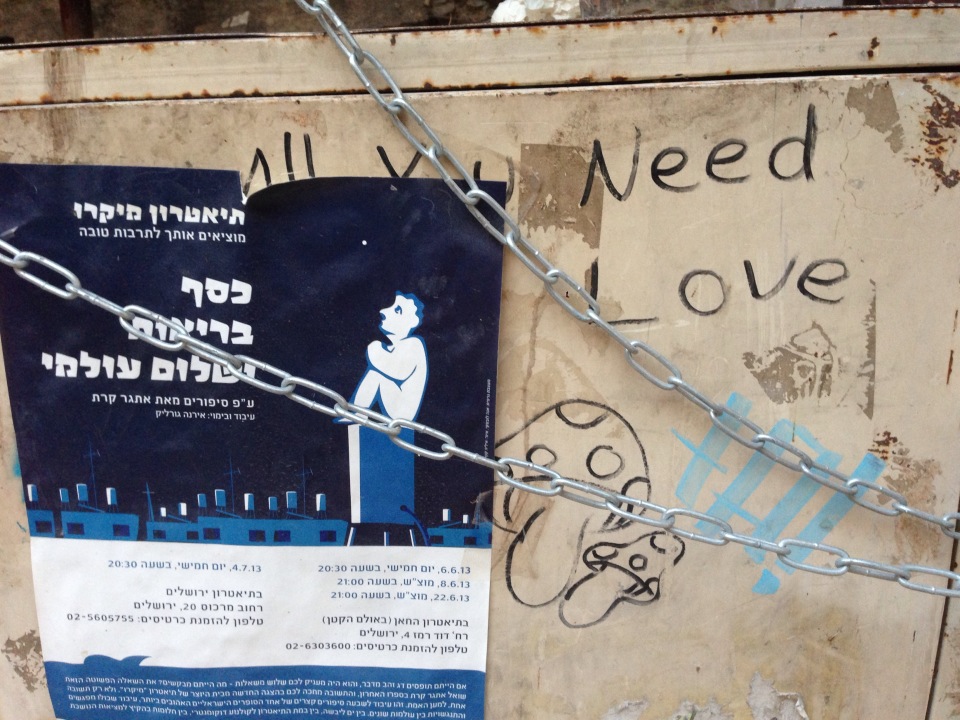
More photos from the tour coming soon… Thanks to T’ruah, and our incredible guide, Marisa, for taking us on a literally eye-opening tour.
Check out my new piece for eJewish Philanthropy! Originally posted here.
In the past year, the North American Jewish community became more aware of the critical role North American madrichim play in the Taglit-Birthright Israel experience.
Many in the Birthright community have observed the challenges associated with the North American staffing model, where there has been a less than tongue-in-cheek acceptance that the real substance of the trip “magically” happens at the hands of the Israeli tour guide, while the madrichim are viewed as little more than glorified babysitters. Thankfully, we’ve also heard responses from some (here and here) who are working to address these crucial challenges.
While Birthright participants do experience Israel with elements of surrealism and awe; and while we often speak of the “magic” of the Israel experience; Birthright is no magic trick. It involves great dedication, knowledge, skills, passion, and real work in both the months leading up to the trip, and in the months and years following the trip. Far from an elaborate illusion, Birthright is deeply rooted in reality.
So perhaps it is particularly poetic that a significant change within the Union for Reform Judaism’s birthright program – Kesher – took place just days before the start of Hanukkah, a holiday often associated with the magical story of oil lasting for eight days. We know that the reality of Hanukkah’s story is actually of a monumental change in the Jewish community that involved the real blood, sweat and tears of many Jews. To be sure, the name of the holiday itself teaches us of the inherent importance of dedication and rededication in shaping a lasting Jewish community.
With more than 40 Kesher Birthright trips per year, including over 1,700 participants and Israelis and upwards of 80 madrichim, it had become increasingly apparent that it was time to rededicate ourselves to the importance of our Birthright madrichim.
Empowering Madrichim as Experiential Educators
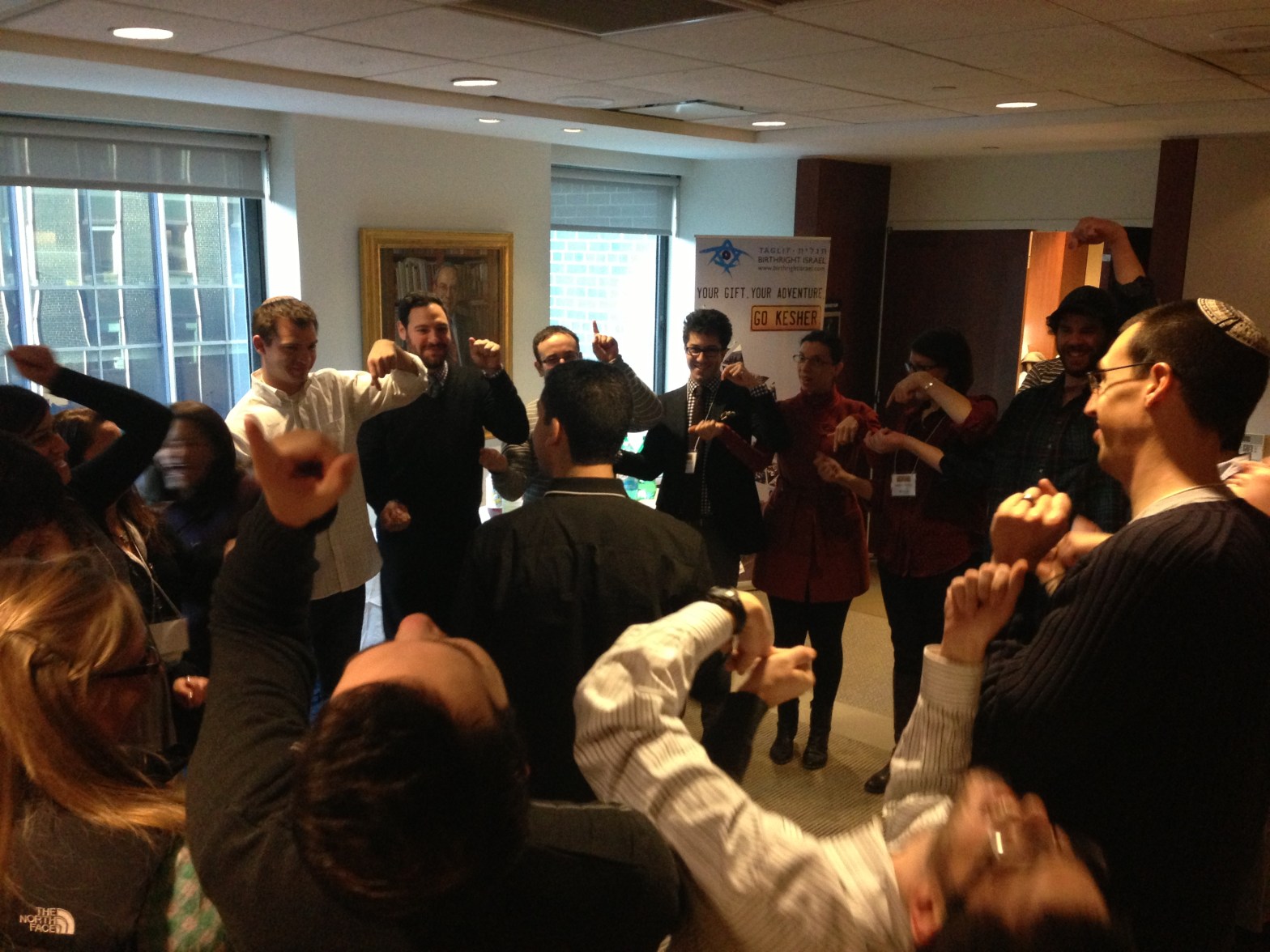
In early December, Kesher staff flew from all corners of North America to New York City for an intensive two-day in person staff training program. This rejuvenated, rededicated program was fully funded at no expense to the madrichim, who significantly volunteer their own time and energy with no financial remuneration. The training program was designed to bring the staff community together to learn from professionals in Jewish Experiential Education, share their own best practices, and meet and work with their co-staff in the months leading up to the trip (instead of at the airport just four hours prior to their trip).
Our goals were to empower the madrichim as Jewish experiential educators in their own right, to create an understanding of and dedication to our educational vision and mission, and to foster a strong staff community that would continually be a mutually supportive cohort. Through both a practical and theoretical paradigm, we examined the vision and mission of the URJ Birthright program, studied concepts of Jewish identity formation, explored the educational themes and goals of the sites we visit in Israel, and dedicated ourselves to the importance of fostering community before the trip itself begins. We also explored the importance of the 11th day of the program- what happens to participants upon their return to North America. Significantly, the madrichim also moved beyond the “babysitter” approach to staffing, and learned how to look after the participants through a model of “Caring for the Whole Person.”
Valuing Madrichim as Partners in Our Mission
This was an ambitiously designed program, and one that reveals its value over time. We immediately heard from our staff – both seasoned alumni as well as first-timers – that training together in an experiential environment has been rewarding and will contribute greatly to the excellence of the URJ’s Birthright program.
Joining the madrichim for a session was Rabbi Rick Jacobs, president of the URJ. He spoke passionately about his own first encounter with Israel, and about the centrality of the role that dedicated madrichim play as mentors in the Jewish journeys that Birthright participants undergo.
In the coming weeks and months, we look forward to learning more from our madrichim and participants about how this rededicated focus on our staff contributes to the excellence of the Israel experience for all those involved with the KESHER Taglit-Birthright Israel program.
Jesse Paikin is the Israel Programs Coordinator for the Union for Reform Judaism Camp & Israel Programs
Israel, my troubled friend, it seems you never miss the opportunity to tug at my heart in opposite directions. This week, you simultaneously shoot yourself in one foot, while strapping on an attractive new Naot sandal on the other.
So you’re going to construct 1,000 new homes in East Jerusalem? I guess that shouldn’t surprise me. It’s certainly in keeping with the way you’ve been acting lately.
Though even when you punch me in the gut like that, with your other hand you lift me up and caress my tear-streamed cheek. Yesterday it was announced that a group of prominent Israelis, including former chiefs of the IDF, Mossad, Shin Bet, are presenting a new straightforward peace plan, based in part on the Arab Peace Initiative. It seems this group of Israelis also intends to rile up support among the Israeli populous and push the government to act upon the plan.
At the end of the day, as complex and confounding as the Israeli/Palestinian situation may be, it can also be remarkably simple, at least for those who want Israel to exist as a respected Jewish Democracy. Watch the creatively produced video above for some insight along those lines.
The new Israeli peace plan could fail. It probably will. But hope is always better than despair. Sentiments too corny? Fair enough. For the emotionally detached, just watch the video above and root your opinion in the fast-approaching demographic reality.
 A few weeks ago, Ha’aretz published an article criticizing the scope and educational content of Birthright Israel trips, arguing that participants don’t get to interact with the real Israel, instead seeing a “romanticized” and idealized “Jewtopia” that is carefully constructed by the trip organizers to gloss over the truth of life in Israel.
In the article, author Leah Molayem writes that,
“While Taglit offers an undeniably unique opportunity that encourages Jews who have never been to Israel to learn more about their historical roots, it is important to recognize the one-sided conditions under which participants are introduced to Israel, and ultimately depart with an understanding and appreciation that deviates from reality.”
While I can’t speak for all Birthright organizers – and I was disappointed to read that Molayem had an unengaging experience on her own trip – I was immediately taken aback by her thesis. I’ve been fortunate enough to lead a number of Birthright trips through the Reform movement, and happened to have just returned from leading one the day the article was published. My own first trip to Israel was also with Birthright. Her description is the polar opposite of what I’ve experienced on all trips.
It is true that each trip organizer has its own focus and paradigm, and the Reform movement’s trips by nature are certainly more inclined to cover a wider swath of Israeli society, providing a holistic and mostly transparent view of daily life there. I’ll also grant that a ten-day trip can only cover so much; by nature, Birthright is intended to be an introductory experience.
But do all Taglit trips present a “one-sided” view of Israel where participants “ultimately depart with an understanding and appreciation that deviates from reality”? Let the experiences recorded here testify to the falsehoods of these accusations.
Molayem writes that she “found that the Arab-Israeli conflict, socioeconomic divisions and the ethnic and religious rifts within Israel are carefully avoided in discussions by the trip organizers, who work tirelessly around the clock in an attempt to create that Jewtopia.”
It is unfortunate that Molayem didn’t have the chance to engage with these important issues. A URJ-Kesher Birthright trip engages with each of these issues, and more. Participants visit an Arab-Israeli village for a dialogue at a Mosque and in the home of a villager, tour the separation barrier, volunteer in a poor neighbourhood of Ethiopian immigrants, explore the difficulties of life for the northern Druze population, and interact with members of Israel’s progressive Jewish community, discussing religious pluralism.
I don’t want to turn this post into a brochure for one organization’s trips, but do want to highlight that the very lacunae that Molayem identifies are a central and significant part of the Reform Movement’s pedagogy on its trips. This is important and should not be ignored. There are organizations that provide an enriching, engaging, and holistic view of Israel.
Of course, given the laws of physics, there really is only so much that you can see, do, and talk about in ten days. And of course, a good chunk of time on the trip takes advantage of the fun and entertaining activities Israel offers as a tourist destination. But Molayem is dead wrong in her characterization of Birthright participants as “tourists.” On a URJ-Kesher trip, it’s emphasized that participants are pilgrims, engaging with a land they already have a deep-seeded connection to. The purpose of the trip is to let those seeds begin to grow into a stronger tree. Does that tree fully grow on the trip? Of course not, it’s only ten days! But it certainly pushes up through the ground and begins to flourish.
Molayem – to her credit – concludes the article with a number of suggestions of issues to engage with to improve the Birthright experience: daily life in Jaffa, the Haredi sector, and gender-equality at the Kotel. What she failed to realize is that there are trips that are already doing this, and doing it well!
Don’t want to take my propaganda at face value? I highly suggest reading the eloquent blog posts written by a participant of mine, Angela, summarizing her own experience. You’ll see it’s the antithesis of the trip Molayem describes.
You can read her reviews here and here.
You may also want to read Brandeis University’s research and report on the long-term impact of Birthright.
 Yesterday, I responded to B’nai Brith Canada’s claim that they were in possession of “The truth” vis a vis the Israel/Palestine/Jewish/Muslim/Arab/Middle-East peace process, and that an anonymous “They” was trying to subvert access to this “truth.”
So let’s talk about “The Truth.”
In 2005, I was invited to speak at the URJ Biennial in Houston as a member of a panel on Israel Engagement. I was representing the university age group, and I was supposed to talk about Israel advocacy, Reform Zionism, and combating anti-Israel sentiments on campus.
Coming out of the Israel/Palestine/Jewish/Muslim/Arab/Middle-East climate at York University heavily affected my perspective. The topic was a particularly divisive one at York, and I had grown tired of the vitriol from both “sides” of the debate.
So the thesis of my panel presentation went something like this:
“If you’re going to talk about Israel on campus, you need to root yourself solidly and almost exclusively in factual truths. You need to avoid the emotionalization of the debate, and stay away from the impassioned yelling fits.”
Because that’s what the debate had become – a perpetual round of who-can-scream-louder-than-the-other-“side”.
Having just returned from Israel where I had some unique opportunities to engage with the Israeli Arab community, I find more than ever that the truth might actually be at the root of the problem – both in the Middle East and abroad.
Keeping your debate to truths is all fine and good, and may indeed circumvent some of the yelling and screaming and red faces and holier-than-thou shouting, but there’s just one problem…
Both “sides” have equally valid truths.
I’ll pause for a moment and explain the copious use of quotation marks around “sides”.
There really aren’t two sides to this issue, each with their own opposing history… it’s one large story, with intertwined narratives, facts, and truths. This is not Jew vs. Muslim, Arab vs. Non-Arab, Israeli vs. Palestinian, or any other false dichotomy. The longer we continue to view this as a polarized issue, the longer it will remain that way – polarized and unsolved. Certainly, at this point in world history, it’s clear that if you want to talk about Israel/Palestine/Jewish/Muslim/Arab/Middle-East, you should understand that it’s one vastly complex narrative, not two separate storybooks.
Back to the Truth… in this one, complex story, there are a number of equally valid truths. For example:
– It’s true that years of terrorism have led to Israel needing to take strong security measures.
– It’s true that the State of Israel has a long and valid connection to the Land of Israel.
– It’s true that many Palestinians were displaced because of the forming of the State of Israel.
– It’s true that life for non-Jewish Israelis is often much harder than life for Jewish Israelis.
– It’s true that Israel needs to defend itself against internal and external threats.
– It’s true that Israel bears responsibility for the actions it takes in the West Bank.
And so on…
It’s very convenient and easy for much of the pro-Israel community to just focus on the truths from the Israeli “side” of the narrative, because it makes it look like Israel is justified in all of its actions. Unfortunately, that leaves out half of the story.
The pro-Israel community as a whole needs to work on being less myopic, and start looking at the bigger picture, not just Israel’s “side” of it. This is why I’m so fond of J Street. Not because they’re “liberal,” “progressive,” or “pro-peace,” but because they engage in a holistic viewing of the situation Israel faces.
Compare their perspective with B’nai Brith Canada’s. When B’nai Brith claims to be in possession of the “Truth,” what they’re essentially doing is delegitimizing anyone whom they deem as being opposed to their view of the “Truth.” So the reality of daily life for non-Jewish Israelis is irrelevant, the reality of daily life for Palestinians is irrelevant, the future demographic realities Israel will face are irrelevant, and the realities that President Obama and Prime Minister Netanyahu are willing to confront are irrelevant because they are not “the Truth.”
The “truth” is all fine and good, but only if you’re open to other people’s truths as well.
A dangerous cocktail.
The Tories used their MP’s free-mail privileges to send flyers to households in communities with large Jewish populations in Montreal, Toronto, and Winnipeg. These flyers (see one here) were an attempt to convince voters (is there an election brewing?) that the Conservative Party is more committed to Israel – and thus, by extension, the Jewish population of Canada – than the other political parties. This is astonishing. On many levels:
1. This is an abuse of taxpayer funding. These flyers were sent for free, under postal rules allowing MPs to send mail to their constituents in the interest of public information. But this is not information being sent, it is narrow-casting propaganda that in fact misinforms (see my third point) the populous. These are essentially attack-ads being funded by public dollars. Would this be acceptable during an election?
2. This is also a fiscally unsound abuse of taxpayer funding. Could the Tories at least be economically frugal with their propaganda? A report issued this week by the Globe and Mail notes that, while MPs of every party make use of free mail privileges, the Conservatives spent $6.3-million on the mailers last year, while opposition MPs spent $3.8-million. What happened to the Tories’ self-professed “fiscal accountability”?
3. In a strange world, this might all be acceptable were the information included in the flyers in fact true. One might excuse Tory MPs for spending millions of dollars on informing the Canadian public that the Toronto Maple Leafs are having a terrible season and there should be an appropriate public response. But the accusations leveled here are just incredible. Quite literally, they are not credible. The ad argues that:
A) Canada’s presence at the Durban Conference in 2001, under the leadership of the Liberals, was an indicator that the Grits are complicit in foreign anti-semitism. In reality, the Israeli government at the time specifically asked the Canadian delegation to remain to “make its voice felt and bear witness to what was happening,” noted Liberal MP (and former Minister of Justice and current Jewish luminary) Irwin Cotler.
B) The Liberals are soft on fight terrorism, and they “opposed defunding Hamas,” and “asked that Hezbollah be delisted as a terrorist organization.” In reality, it was the Liberal party in 2002 that had Hamas and Hezbollah classified as terrorist organizations. Moreover, it was the personal musing of a Liberal MP who wondered if Hezbollah might be delisted. While reprehensible, that personal musing cannot be taken to be a party stance of the Liberals, as MP Joe Volpe argues.
C) The Liberals do not support Israel, as Michael Ignatieff accused Israel of committing war crimes in 2006. While Iggy did indeed did make this accusation once during the war against Hezbollah, he later publicly apologized. So accuse him of flip-flopping if you want, but don’t make this false corollary. Even if Israel committed war crimes, that doesn’t mean saying so lessens support of the country, it’s just an analysis of military strategy. This is just misleading and playing to people’s emotions.
At the end of the day, I’m floored that this abuse of power, money, and privilege took place. MP Cotler, eloquent in his shock, noted that “this goes beyond the pale of politics, this is an abuse of privilege and … I will call I what it is, it’s a lie … this stuff is scurrilous.”
My body is back in New York. This afternoon, it will be in Toronto. My mind (and my internal body clock) are still in Israel. Along those lines, some thoughts for 5770, courtesy of my favourite journalist-cum-theologian, Bradley Burston:
Perhaps the time has come to ask, as the Talmud asks, “Who is a true hero?” The sage Ben Zoma responds that the true hero is the person who succeeds in conquering the basest of impulses, the worst of human instincts.
In an age of quietly tyrannical political correctness and instant-messaging, the complex heroism of individual Israelis may have no place. Israelis themselves have by and large learned to hide it, to dismiss it, to denigrate it…
…the secret heroism of Israelis is by no means confined to the military. Large numbers of Israelis work tirelessly, heroically, to help pave the way to a common future with the Palestinians. Many Israelis have opened their hearts to helping refugees from foreign genocides. Their stories go largely unnoticed abroad, in no small part because it takes work to make a people long marketed as villains, into flesh and blood fellow humans.
This is the truth. It is politically incorrect in the extreme. It muddies the colors of cardboard ideology and blanket support for one angelic side over the diabolical.
May 5770 be a year of truth, politically incorrectness, and an end to cardboard ideology.
See you next week, when I fire up Billboard Judaism.
Shana Tovah!
A review of my experiences at yesterday’s pro-peace Rally, this is Part 3 in a series of posts on rallies related to what’s going on the Mideast. Read Part 1 and Part 2.
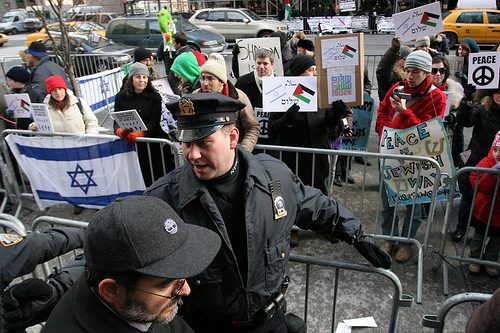
Today, as I think about yesterday’s rallies, I am certain of three things:
1. The frequency of people tagging blogs with “Gaza,” “Israel,” and “Palestine,” has shot through the roof. Needless to say, not everything is newsworthy or even cogent, but at the very least, it does indicate an increased awareness.
2. In my next post, where I focus on what a rally really is, and what it really needs to entail, I’ll argue that the vast majority of the 10,000 people at the pro-Israel “rally” don’t know much about what they are supposedly rallying for. For now, I’ll throw this out there in support of why our protest was a real rally, and the other wasn’t:
No dialogue resulted from the other “rally.” It was just a bunch of guys on a podium shouting platitudes, with a bunch of people cheering. There was no working to bring about change. It was monolithic. Everyone even looked alike, as all were given “tzeva adom” (red alert) hats to wear. The organizer informed the multitudes that these hats were “a symbol that the missiles would stop falling, and the alerts would end.” Right. Hats. Why not take the money that was spent on the hats, and donate it to assist those lives in peril in southern Israel? That’s really advocacy. That’s real activism.
At our rally, there was dialogue (albeit hostile at times), that had the express intent of bringing about a change to the status quo in the Jewish community. We may not have changed people’s point of view, but we made it undeniably clear that this is not a black and white issue. We got attention from a wide variety of media and press, including Radio-Canada, who interviewed me in French when they heard I was Canadian. They all seemed mildly surprised that there could possibly be supporters of a “middle-way.” No surprise, given that much of the media was focused on the giant stage on 42nd Street.
3. Here’s a run-down of the colourful remarks hurled – by Jews – at me and others yesterday:
“You’re leading the way back to Auschwitz!”
“You’ll bring about another 9/11”
“You’re not Jewish! Take off your kippas! You’re not a real Jew!”
“There are no innocent civilians in Gaza!”
“Shame, shame shame!” (Repeat, ad nausea…)
Deeply hurt, I didn’t take any of these slurs personally. They hurt because they’re a stewing indicator of the inability of people to see beyond their own point of view. If there is a solution to the shit, it lies in people who are able to see beyond their limited horizons and outside of their borders.
While I’m not so sure I want to remember everything, I’ll have photos and video posted soon.
—
Next up, Part Four: Rallying the way to Victory
Where was the Toronto Star three months ago, when I needed them to back me up? Now, after facing a small amount of backlash for my repeated arguments that the Conservative Party of Canada was able to win in my riding of Thornhill by attracting the votes of Jews who would vote for whichever party looked like they supported Israel more, Thomas Walkom – National Affairs Collumnist – has penned an article on ethnic voting and identity politics that backs up the very arguments I postited. Here’s an excerpt:
…In a world where no single party can command a majority of MPs, individual ridings become even more significant. And among some voters in some ridings, support for Israel is a make-or-break issue… Identity politics predates Confederation… In ridings where there is a significant Jewish population, this matters. Kent, for instance, may back Israel as a matter of deeply held principle. But if he did not, this might well hurt him in Thornhill, a riding that he narrowly won last year…
While this is pretty much a closed issue that I hadn’t intended on revisiting, the situation in the Israel and Gaza has brought it to light again. So thanks, Thomas. I couldn’t agree with you more!

 Rabbi Jesse Paikin