On Jewish Activism. Part I: Backburner Zionism

This was originally going to be one long post, but I’ve decided to split it in two for sake of ease. Today, in part one, I’ll identify a specific issue of great importance to Jewish activism, parse it out, and propose a few solutions. Tomorrow, in part two, I’ll take a look at the theoretical underpinnings of this issue and propose a new (though not that new) paradigm for Jewish activism of all kinds.

12.05.2009 UPDATE:I’ve changed the title of this post to reflect the direction my thoughts are moving in. It now looks like this will be a three-part series. You can read part two here.

* * *

About a year ago, in a series of posts, I commented on the trend for pro-Israel (what does that mean, anyways?) rallies to go around masquerading as a form political/social activism, while ultimately being nothing more than glorified (and in some cases, undignified) cheer-leading.

The gist of my argument was that while 10,000 people at a rally or boycott makes a nice, loud statement for the press, the trade-off is that you lose the ability to ensure that those 10,000 people stay intimately invested and active with the cause; most of them will go home with a false sense of accomplishment. The flip-side is that a small, grassroots political or social movement may maintain more personal involvement, but it can lack the punch of a 10,000 strong rally.

Case in point: recent attempts by anti-Israel folks to boycott Canadian companies that deal directly with Israel (specifically Mountain Equipment Co-Op and the Liquor Control Board of Ontario) have prompted the Canada-Israel-Committee and UJA Federation of Greater Toronto to launch www.buycottisrael.ca – a campaign to get people to purchase the Israeli goods in question. A nice idea. Israel’s economy could certainly use help.

But if the overarching issue at hand as viewed by the CIC is that Israel’s economy does not deserve to be boycotted and that it should be supported by those in the international community, then why is there not a continually active “Buy Israel” movement sponsored by the CIC and Federation? (During the height of the intifada when tourism waned and Israel’s economy took a serious hit, there was such a movement in cities with large Jewish populations, though that has fizzled out as the intifada ended and there’s been less for people to react to). Why be reactive when you can be proactive?

I’m led to believe that the issue is less about an ingrained belief in the importance of economic support for Israel and more that the CIC and Federation don’t like it when other people speak out or organize against Israel. It’s easier to react to others than it is to stand up and maintain a proactive stance for something you believe in. Which is not to say that the boycott shouldn’t be responded to. It should. I don’t believe that Israel’s economy deserves to be singled out in this way, but that’s a separate topic of discussion. Do I believe that the CIC, Federation, and those who went out to buy underwear from Mountain Equipment Co-Op truly care about Israel and it’s financial stability? Absolutely. But do they care enough to make these actions a part of their ethos? Aye, there’s the rub.

If the goal of the counter-boycott was just to raise money for Israel and Israeli companies, then it was a success. But if there’s a greater goal, as one might assume from reading the Canada Israel Committee’s mission statement, then it is not entirely a success. The CIC’s mission seeks “the promotion of increased understanding between the peoples of Canada and Israel,” and seeks to “enhance Canada-Israel friendship.” Noble goals. Does the BUYcott lead to the achievement of these goals? Not so much.

This counter-boycott just balances the equation set in motion by the boycott, it doesn’t rise above it. It’s reactionary, and worst of all – like rallies – promotes a false sense of activism. Unless buying Israeli products is part of a larger movement by the purchaser to be actively and intimately involved in strengthening the Israeli economy, or in carrying on substantial discussions with the anti-Israel group, it remains a passive project wearing the mask of activism.

Yes, a tangible result is attained from the counter-boycott: Israel’s economy is supported (good) and the boycott is counteracted (which it turns out didn’t enjoy that much public support to begin with). And none of this is bad on its own. But it’s a closed project, it ends when people bring their clothes home from Mountain Equipment Co-Op. It’s just a step above chequebook Zionism.

To meet the stated goals of the CIC and Federation, and to take this BUYcott from a passive display to a proactive, sustainable, educational, and meaningful initiative, I propose the CIC and Federation use these questions as a guide:

– Where are the educational materials on Israel’s economy?

– Where is the list of Canadian vendors that carry Israel products?

– Where are the talking points for productive discussions with the boycotters?

– Where are the resources on Canadian economic and business partnerships with Israeli companies and organizations?

– Where are the resources on ethical sourcing?

– Where are the calls for further and sustained action?

– And most importantly, where are the communication tools and resources to form a peer-to-peer network? That would truly promote understanding between people and increase friendship. (To be fair, there are facebook and twitter links on the buycottisrael.ca website, but they are in the footer, and aren’t framed as an integral part of the campaign).

If organizations – both Jewish and non-Jewish – want to enjoy popular support that is sustainable, lasting, and intimate, they need to foster that attachment. It must be a central part of the framing of all messaging. It won’t come from just reacting every time a person or group says something they don’t like.

Rallies (or group shopping trips) are exciting and they create noise and attention, but at the end of the day, the day ends. What comes afterwards? Keep a pot of water on the back-burner, and it will just simmer there until the water boils off. Want that pot to be a smorgasbord of activism? You’ve got to keep it in the front and stir it up, and keep feeding it ingredients.

Tomorrow, in Part 2, I’ll look at moving the pot from the backburner to the front.
And as things fell apart, nobody paid much attention

A pondering:

In the history of the world’s civilizations, when did the act of murder switch from being just a bad thing that was a nuisance, to something that is wholly agreed on by (sane) people to be both bad and immoral; something that merits the force of government and society at large to prevent, protect against, and punish offenders when necessary?

A corollary:

In the history of the world’s civilizations, when will abuse of the planet’s resources, wanton destruction of natural habitats to satisfy our constant need for stuff, cruelty to animals for the sake of human pleasure, and corporate control of destructive energy production switch from being seen as things that might be bad but are “necessary” to maintain the standard of living most (western) people are accustomed to, to things that merit the force of government and society at large to prevent, protect against, and (truly) punish offenders when necessary?

Put another way: we don’t have world conferences on murder. We may disagree about how to deal with those who commit murder, and the best ways to prevent it, but we’re long past debating whether or not murder is a problem, whether or not it is immoral. When will the plethora of human activities that are destroying of our planet switch from being agenda items that are paid lip service to at world summits to things that we all agree are horrible, wrong, and immoral?

We talk about a greening revolution and the resurgence of environmentalism, but there hasn’t really been a true paradigm shift. Until we look back on our history and find it impossible to believe that we used disposable, toxic, plastic bags to carry our groceries home, we’re still in trouble. Until using plastic bags is viewed as an immoral, unethical act, we’re in deep trouble. And that’s just one example.

Until we look back on our perversion of the Earth as part of our uncivilized, unenlightened past, immoral past, we’re just as bad as the Romans were when they killed humans for sport.

Power, Money, & Privilege

A dangerous cocktail.

The Tories used their MP’s free-mail privileges to send flyers to households in communities with large Jewish populations in Montreal, Toronto, and Winnipeg. These flyers (see one here) were an attempt to convince voters (is there an election brewing?) that the Conservative Party is more committed to Israel – and thus, by extension, the Jewish population of Canada – than the other political parties. This is astonishing. On many levels:

1. This is an abuse of taxpayer funding. These flyers were sent for free, under postal rules allowing MPs to send mail to their constituents in the interest of public information. But this is not information being sent, it is narrow-casting propaganda that in fact misinforms (see my third point) the populous. These are essentially attack-ads being funded by public dollars. Would this be acceptable during an election?

2. This is also a fiscally unsound abuse of taxpayer funding. Could the Tories at least be economically frugal with their propaganda? A report issued this week by the Globe and Mail notes that, while MPs of every party make use of free mail privileges, the Conservatives spent $6.3-million on the mailers last year, while opposition MPs spent $3.8-million. What happened to the Tories’ self-professed “fiscal accountability”?

3. In a strange world, this might all be acceptable were the information included in the flyers in fact true. One might excuse Tory MPs for spending millions of dollars on informing the Canadian public that the Toronto Maple Leafs are having a terrible season and there should be an appropriate public response. But the accusations leveled here are just incredible. Quite literally, they are not credible. The ad argues that:

A) Canada’s presence at the Durban Conference in 2001, under the leadership of the Liberals, was an indicator that the Grits are complicit in foreign anti-semitism. In reality, the Israeli government at the time specifically asked the Canadian delegation to remain to “make its voice felt and bear witness to what was happening,” noted Liberal MP (and former Minister of Justice and current Jewish luminary) Irwin Cotler.

B) The Liberals are soft on fight terrorism, and they “opposed defunding Hamas,” and “asked that Hezbollah be delisted as a terrorist organization.” In reality, it was the Liberal party in 2002 that had Hamas and Hezbollah classified as terrorist organizations. Moreover, it was the personal musing of a Liberal MP who wondered if Hezbollah might be delisted. While reprehensible, that personal musing cannot be taken to be a party stance of the Liberals, as MP Joe Volpe argues.

C) The Liberals do not support Israel, as Michael Ignatieff accused Israel of committing war crimes in 2006. While Iggy did indeed did make this accusation once during the war against Hezbollah, he later publicly apologized. So accuse him of flip-flopping if you want, but don’t make this false corollary. Even if Israel committed war crimes, that doesn’t mean saying so lessens support of the country, it’s just an analysis of military strategy. This is just misleading and playing to people’s emotions.

At the end of the day, I’m floored that this abuse of power, money, and privilege took place. MP Cotler, eloquent in his shock, noted that “this goes beyond the pale of politics, this is an abuse of privilege and … I will call I what it is, it’s a lie … this stuff is scurrilous.”

An end to Cardboard Ideology

My body is back in New York. This afternoon, it will be in Toronto. My mind (and my internal body clock) are still in Israel. Along those lines, some thoughts for 5770, courtesy of my favourite journalist-cum-theologian, Bradley Burston:

Perhaps the time has come to ask, as the Talmud asks, “Who is a true hero?” The sage Ben Zoma responds that the true hero is the person who succeeds in conquering the basest of impulses, the worst of human instincts.

In an age of quietly tyrannical political correctness and instant-messaging, the complex heroism of individual Israelis may have no place. Israelis themselves have by and large learned to hide it, to dismiss it, to denigrate it…

…the secret heroism of Israelis is by no means confined to the military. Large numbers of Israelis work tirelessly, heroically, to help pave the way to a common future with the Palestinians. Many Israelis have opened their hearts to helping refugees from foreign genocides. Their stories go largely unnoticed abroad, in no small part because it takes work to make a people long marketed as villains, into flesh and blood fellow humans.

This is the truth. It is politically incorrect in the extreme. It muddies the colors of cardboard ideology and blanket support for one angelic side over the diabolical.

May 5770 be a year of truth, politically incorrectness, and an end to cardboard ideology.

See you next week, when I fire up Billboard Judaism.

Shana Tovah!

Dr. Maimonides would be proud

Judaism + Health Care + Politics = an equation you NEVER have to think about in Canada. Down here in Jesusland, it’s an entirely different story. If you haven’t been engrossed in the raging, virulent debate that’s been taking place the past few weeks, consider yourself lucky.

I’m not really going to weigh in, aside from stating that I generally support Obama’s plan. My only hesitation is that I don’t think it goes far enough. But that’s another post.

On the Judaism front, I’m trying to formulate a cogent argument as to why almost all of Jewish thought lines up in support of a socialized health care. For now, I’ll defer to Rabbi David Saperstein who has made the argument that the Talmud itself calls for universal health care:

“by the time of the Talmud 2,000 years ago, [the moral norms of the Torah] had developed into health care systems and rules and requirements to provide adequate health care for all people. Any community that wanted to be considered a moral community had to provide health care, had to provide health care providers. These are not new ideas.”

Old White Jewish Men

Last Friday afternoon, B’nai Brith Canada sent out a news release. They do this often. Stuff happens in the Jewish community, and they send out a news release. Stuff happens in the Christian community, and they send out a news release. Someone farts at York University, and they send out a news release. While the many emails from “JEWISH CANADA” can become annoying at times, I ultimately commend them for remaining diligent in their communication efforts – they do a much better job than many other Jewish organizations.

But. Last Friday’s email was different. The title was:

United Church of Canada Resolutions Insult to Grassroots Canadian Jews

Hmm. Something jumped out at me. Angered me a little. Can you spot it? Moving on, the first sentence in the email read as follows:

B’nai Brith Canada, the voice of the grassroots Canadian Jewish community, was disappointed to learn that resolutions that enable United Church Conferences, Presbyteries, congregations, and community ministries to boycott the Jewish State of Israel, if they so choose, were unanimously passed at the United Church of Canada’s (UCC) 40th General Council.

How about now?

B’nai Brith is many things. They’re a Jewish advocacy organization. They’re an Israel advocacy organization. They’re a human rights advocacy organization. Their newspaper in Canada claims to provide “the real story – and the story behind the story – from a Jewish perspective,” though more often than not, that appears to be code for the Right Wing perspective. I should also say that they run a number of summer camps, and Jewish camping is more than important to me. They are indeed many things, but they are certainly not grassroots.

What is grassroots? For starters, labeling an organization as grassroots implies that there is a movement behind the organization. It implies that a collection of people – the roots – have come together independently to identify as a group with a shared philosophy. What is the B’nai Brith movement? Visit the “About Us” section of the website, and you’ll learn that:

B’nai Brith Canada is the action arm of the Jewish community. We believe in:

1. Reaching out to those in need
2. Fighting antisemitism, racism and bigotry;
3. Promoting human rights and peace throughout the world.

What is B’nai Brith’s philosophy? Their ideology? Their social perspective? These are things we would expect to know about a movement. How many people today will claim that they are part of the B’nai Brith movement?

The term also implies that the movement and its related organizations evolved spontaneously and naturally as a response to some stimulus. B’nai Brith – at least in the USA – certainly had a grassroots origin, with German-Jewish immigrants gathering to do something about the squalor in which Jews were living at the time. But now they have evolved into something beyond this grassroots origin. They do wonderful work, representing their constituents and advocating on behalf of certain Jewish views, but they are far past the days of being a small, grassroots movement. To be sure, they are part and parcel of the Jewish establishment. Meet your friends Federation, the World Zionist Organization, the Jewish Agency, and the State of Israel.

Labeling a group grassroots is also a way to highlight the differences between that group and its accompanying movement, and other organizations governed by more traditional power structures. A quick glance at B’nai Brith and B’nai Brith Canada’s websites is more than enough to show you that they are intimately familiar with “traditional power structures,” as the names and pictures of their leadership look like they came from a Facebook group called “old white Jewish men.”

The labeling of B’nai Brith Canada as grassroots is a curious move by the organization. For one, it is an abrupt change – they’ve never called themselves this before. Last Friday’s email was the first appearance of this adjective. Why, all of a sudden the need to add this term in August 2009? (8.28.09 Update: Turns out they have called their constituency grassroots a few times before. Mostly in press releases.)

I take great issue with this. It’s an attempt to make it look like they aren’t facing declining relevance like the rest of the organizational Jewish world. It’s an attempt to make it look like they don’t have a member base that’s almost entirely made up of people who were born before 1950 (not that there’s anything wrong with people born before the invention of the VW minibus). It’s an attempt to make it look like they attract the same type of people that Obama attracts.

There’s a term for what B’nai Brith is doing. It’s called Astroturfing. And in the political, advertising, and PR world, this is a BIG no-no. By calling themselves grassroots, B’nai Brith Canada is trying to project an image of something it isn’t.

Let me re-iterate: B’nai Brith does many wonderful things, many vital things for the Jewish and broader communities in Canada and the US. But they are not grassroots. To try and present this image is dishonest and unfair.

I’m also left with a few final questions from B’nai Brith’s email of last Friday…

Is there a difference between “grassroots” Canadian Jews and “regular” Canadian Jews? And if so, is the Canadian Jewish community insulted and disappointed en masse, or is just the “grassroots” Jews? And if so, is B’nai Brith really the voice of the entire “grassroots” Canadian community?

This is where B’nai Brith shows their true colours. You can’t just blanket label a group of people as grassroots. At the end of the day, I’m left wondering what B’nai Brith Canada’s “grassroots” movement is all about…

Leonard Cohen’s “psycho-religious” Jewish Journey, Part II

This is a brief follow up to an earlier post about Leonard Cohen‘s incredible Jewish Journey and status in my books as an all around kick-ass dude.

It seems The Forward generally agrees with me that this is a man who should not be ignored. In an article this week, the Jewish paper covered an interesting incident that transpired outside on of his Radio City concerts.

Turns out that instead of a camp-out for tickets, it was the myopic and hypocritical anti-Israel throngs who were making noise outside of Radio City, in an attempt to boycott his concert (did they have tickets? Was it really a boycott if they never had tickets?) and hold a rally, all in a vein attempt to get Cohen to cancel an upcoming concert date in Israel.

I’ve got three things to say:

1. Cohen is exactly the kind of person who these protesters should be encouraging to go to Israel. He is unsatisfied with the status quo, is an ardent supporter of a two-state solution and equal rights, and regularly uses his music to rouse the populous out of dormancy. They should charter a jet and send his ass into Jerusalem right now.

2. Political ponderings aside, the Forward article makes an interesting (and very brief) statement about the differences between Canadian and American Jewry. Check this excerpt out:

Born and raised in Montreal, where he attended Orthodox day schools through high school, Cohen is one of a trio of iconic figures in the city’s intensely ethnic Jewish culture, along with late novelist Mordecai Richler and poet A.M. Klein. All three became towering figures in Canada’s general culture through writings that were deeply suffused with their Jewish experience, in much the same way as American writers such as Philip Roth and Saul Bellow. Unlike the Americans, however, the three Canadians remained deeply engaged with Judaism and the Jewish community throughout their lives.

3. Any article that includes the phrase “a live psychodrama of his psycho-religious career” is worth reading. Check it out.

Israel vs. The Rest, Part Three

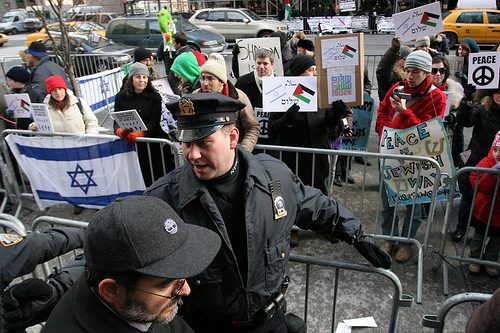
A review of my experiences at yesterday’s pro-peace Rally, this is Part 3 in a series of posts on rallies related to what’s going on the Mideast. Read Part 1 and Part 2.

3188707165_5edebe5bd41
Today, as I think about yesterday’s rallies, I am certain of three things:

1. The frequency of people tagging blogs with “Gaza,” “Israel,” and “Palestine,” has shot through the roof. Needless to say, not everything is newsworthy or even cogent, but at the very least, it does indicate an increased awareness.

2. In my next post, where I focus on what a rally really is, and what it really needs to entail, I’ll argue that the vast majority of the 10,000 people at the pro-Israel “rally” don’t know much about what they are supposedly rallying for. For now, I’ll throw this out there in support of why our protest was a real rally, and the other wasn’t:

No dialogue resulted from the other “rally.” It was just a bunch of guys on a podium shouting platitudes, with a bunch of people cheering. There was no working to bring about change. It was monolithic. Everyone even looked alike, as all were given “tzeva adom” (red alert) hats to wear. The organizer informed the multitudes that these hats were “a symbol that the missiles would stop falling, and the alerts would end.” Right. Hats. Why not take the money that was spent on the hats, and donate it to assist those lives in peril in southern Israel? That’s really advocacy. That’s real activism.

At our rally, there was dialogue (albeit hostile at times), that had the express intent of bringing about a change to the status quo in the Jewish community. We may not have changed people’s point of view, but we made it undeniably clear that this is not a black and white issue. We got attention from a wide variety of media and press, including Radio-Canada, who interviewed me in French when they heard I was Canadian. They all seemed mildly surprised that there could possibly be supporters of a “middle-way.” No surprise, given that much of the media was focused on the giant stage on 42nd Street.

3. Here’s a run-down of the colourful remarks hurled – by Jews – at me and others yesterday:

“You’re leading the way back to Auschwitz!”
“You’ll bring about another 9/11”
“You’re not Jewish! Take off your kippas! You’re not a real Jew!”
“There are no innocent civilians in Gaza!”
“Shame, shame shame!” (Repeat, ad nausea…)

Deeply hurt, I didn’t take any of these slurs personally. They hurt because they’re a stewing indicator of the inability of people to see beyond their own point of view. If there is a solution to the shit, it lies in people who are able to see beyond their limited horizons and outside of their borders.

While I’m not so sure I want to remember everything, I’ll have photos and video posted soon.


Next up, Part Four: Rallying the way to Victory

Identity Politics

Where was the Toronto Star three months ago, when I needed them to back me up? Now, after facing a small amount of backlash for my repeated arguments that the Conservative Party of Canada was able to win in my riding of Thornhill by attracting the votes of Jews who would vote for whichever party looked like they supported Israel more, Thomas Walkom – National Affairs Collumnist – has penned an article on ethnic voting and identity politics that backs up the very arguments I postited. Here’s an excerpt:

…In a world where no single party can command a majority of MPs, individual ridings become even more significant. And among some voters in some ridings, support for Israel is a make-or-break issue… Identity politics predates Confederation… In ridings where there is a significant Jewish population, this matters. Kent, for instance, may back Israel as a matter of deeply held principle. But if he did not, this might well hurt him in Thornhill, a riding that he narrowly won last year…

While this is pretty much a closed issue that I hadn’t intended on revisiting, the situation in the Israel and Gaza has brought it to light again. So thanks, Thomas. I couldn’t agree with you more!

Israel vs. the Rest, Part Two: Facebooking the way to Victory

This is part 2 in a series of posts on rallies related to what’s going on the Mideast. Part 1 is here.

I had originally intended my second post in this series to be a look at some organizations and people who actually have the guts to get dirty and actively involved in the causes they are supposedly rallying for. I’ll get to that later this weekend. Instead, I need to comment on another “rally” that is taking place right now, as we speak. I received an email yesterday from the World Zionist Organization – a group that I have been an active member of in the past – notifying me of a 24 hour “virtual rally” on Facebook for the citizens of southern Israel. I almost laughed a little. I though to myself “this is either going to be a forum for some pretty harsh vitriol, or it’s going to be a poorly ‘attended,’ with no discernible positive outcome.”

sderot-facebook1So I checked in on the “rally” a few minutes ago. There are about 4,000 people “attending,” and about 100 people have posted comments on the wall. I’d say that by Facebook standards, those numbers really aren’t much to be proud of; Zoolander and Hogwarts seem to be more pressing causes. I’m not surprised. What did surprise me was the breakdown of wall posts: about 70% were one line platitudes of Israel’s actions, 5% were anti-Arab rants, and one girl had the courage to post that she was leaving the “rally” because it didn’t offer any constructive purpose, aside from providing a forum for Anti-Arab bashing. And what about the other 25%? Well they thought that they were RSVPing to an actual rally, and posted comments regretting their absence. They didn’t even know it wasn’t a really rally. Sad.

The Facebook “rally” isn’t an ultimately terrible thing. It’s not evil, and if residents of Israel take emotional support from it, then I’m not entirely opposed. But let’s be clear: it’s not a good thing either, and it does have one pretty sinister aspect to it. A “rally” like this lives in the realm of fence-sitting, as it allows people to give vocal (or textual) expression to something they support, but doesn’t channel that support into an active cause. It’s apathy masquerading as passive activism. Like this week’s rally at the Israeli Consulate, the Facebook “rally” doesn’t accomplish much. But at least at the New York rally, people got up on their feet and went somewhere. Here, all people did was click a button online.

To be sure, this was part of the marketing of the “rally” as well. My email informed me that “all you have to do is log in and click ‘attending,'” and that that would be a show of my support and sympathy. Wow! Maybe the WZO and Facebook should partner and create a line of virtual bereavement sympathy cards. They could give Hallmark a run for their money.

What’s saddest of all about the Facebook “rally” is that it was being held on Facebook — arguably the greatest social networking tool humanity currently has at its disposal. Had there been any critical and constructive thinking on the part of the planners, this “event” could have channeled people to get out of their offices, and do something. It could have provided educational resources. It could have been a forum for true dialogue. It could have brought together pragmatists, progressives, and true activists from not only the Jewish, Zionist, and Israeli world, but also the Arab, Palestinian, and “other” world! Instead, a “rally” like this one only furthers the notion that the conflict in the Mideast can be viewed through black and white lenses, or through “Attending” or “Not Attending” mouse clicks. It’s all a virtual folly.

Shabbat Shalom.

Next up:
Part Three – A look at the dictionary definitions of the word “rally” and how that should be your first clue as to how these are not real rallies.

Part Four – A look at some organizations and people who actually have the guts to get dirty and actively involved in the causes they are supposedly rallying for.

Part Five – A review of how I got dirty and active.