This is a serious prayer. Time to get serious.

Kaddish_trainer

I have a difficult relationship with the prayer, Kaddish Yatom.

When I was younger and learning how to pray Jewishly, I assumed that what I learned about praying Kaddish Yatom was the same for all Jews – that everyone in the congregation stood and recited the words together. As I prayed in communities beyond my own, I learned that this was not the case – that this was a mostly Reform Jewish minhag (custom), and that in most other Ashkenazi communities, only the mourners themselves rose to recite the text. As it happens, the Reform minhag mirrors that of the Sephardi rite, although I imagine this is purely coincidental and that the two practices evolved separately.

Since learning of the difference in methods of praying Kaddish Yatom, my own practice has evolved. Especially since my own Bubby Jeanne passed away, I have come to appreciate the value and personal meaning found in having a specific moment to myself (along with other mourners in the congregation) to honor her memory and pray to God. This was particularly apparent when I was praying at a Conservative shul during shloshim. For three times every morning, for thirty days, during shacharit, I rose to say the words of Kaddish Yatom and praise God in memory of my Bubby. As one of the only people standing in the congregation, I felt as though my words carried a unique gravitas. This wasn’t just something that everyone did because it was the proscribed time in the service, this was a particular responsibility and honor that I had.

The Reform innovation of having the entire congregation rise to say Kaddish along with the mourners evolved out of a desire to have the community unite in support of the bereaved during their difficult time. There is also a minhag that this is an opportunity to say Kaddish for those that have nobody to remember them – particularly those who perished in the shoah. While I appreciate and understand these motivations – and even find myself compelled at certain times to utter the words of Kaddish for these reasons – I find that they ultimately detract from the deeper meaning of this part of our worship.

If one says the Kaddish Yatom every time they pray – even if they are not mourning or observing a yahrtzeit – how is the kavannah of that prayer distinguished from when it is being said specifically in memory of someone who has died? Does this not detract from the gravitas, uniqueness, and separateness (a critical component of the Jewish notion of holiness) of it being used only during times of mourning and memory?

This conception is not foreign to Reform Judaism – elsewhere in our liturgy, there are countless examples of prayers that are used only at specific times to ascribe additional holiness and significance. Yet for some reason, within Reform worship practices, the Kaddish Yatom seems to already hold this level of added import. In virtually every Reform congregation and community I have prayed in, the same scenario plays out upon arriving at the Kaddish Yatom: Faces become somber. The tone of voices change; you can hear the added reverence. This is not a prayer you just say. Elsewhere in the service, distractions may abound, but when it comes to Kaddish, the transformation in attitude among worshipers is palpable. This is a serious prayer. Time to get serious.

Even in so-called creative services in summer camps or youth groups, where there may be a near-complete departure from the more traditional keva of the liturgy, the elevation of the Kaddish Yatom can be observed. Amidst a service abounding with joyous Beatles, Phish, Bob Marley, and Mumford & Sons songs, you can be sure that at some point, the attitude of the prayer leaders will change. A serious look will come over their faces. And the community will be instructed to rise for the Kaddish. You can’t mess with THE Kaddish.

So as I prayed mincha earlier this week at school, I was pleasantly surprised when Ally, our shlicha tzibbur (prayer leader) for the day, instructed the community to remain sitting before Kaddish Yatom. She shared with us that many people in the community had been saying Kaddish particularly for loved ones who had recently died, and that she wanted to give these individuals an opportunity to share their stories and honor their memories aloud before the entire community. One by one, these people rose on their own, told us for whom they were praying Kaddish, shared a person story of their connection, then rejoined the community.

While this was clearly a creative addition to the structure of the mincha service, it was actually very much in keeping with the meaning of Kaddish Yatom. As I saw it, this was an opportunity for individuals to stand and recognize this period of mourning or memory as separate from their ordinary/daily lives, for them to ascribe additional significance and holiness to the prayer at this time of mourning or memory, and afterwards for them to sit down among the community and receive their support.

Sitting, listening to these stories as part of the framing of Kaddish Yatom was incredibly refreshing. For me, it is often challenging to remain sitting during this prayer. Usually I am the only one, or one of a very small minority. I feel different and separate – ironically, the very feelings I look for when I am saying Kaddish for someone in particular.

Ultimately, the kavannah of other worshippers is their own domain, and I’m not making a blanket suggestion that the dominant Reform minhag is wrong. However, I think some significantly meaningful aspects of the prayer for individual worshippers may be lost through the current practice. And while Reform worship styles are generally quite flexible and open to innovation, there is a remarkable level of orthodoxy when it comes to Kaddish Yatom. As a result, most Reform Jews have never been exposed to a different approach to this prayer.

For such a significant part of our life-cycle commemorations, this troubles me. It being a prayer that is held to such serious standards, shouldn’t it merit an equally serious approach in our search for understanding and meaning within our worship?

Postscript: Ironically, as I was searching for some sources for this post, I stumbled across an article with a very similar thesis that was written earlier this year for Reform Judaism Magazine.
Praying on the very tip of a rabbit’s hair

At school, we’re required to lead a number of services for the community throughout the year. The following is from an iyyun tefilah (contemplation/meditation on prayers) that I delivered as part of shacharit services I led at HUC-JIR in Jerusalem this shabbat:

In Sophie’s World, Norwegian author Jostein Gaarder compares the world in which we live to – of all things – a rabbit:

“All mortals are born at the very tip of the rabbit’s fine hairs, where they are in a position to wonder at the impossibility of the trick. But as they grow older they work themselves ever deeper into the fur. And there they stay. They become so comfortable they never risk crawling back up the fragile hairs again. Only philosophers embark on this perilous expedition to the outermost reaches of language and existence. ‘Ladies and gentlemen,’ they yell, ‘we are floating in space!’ But none of the people down there care. ‘What a bunch of troublemakers!’ they say, ‘Would you pass the butter, please? How much have our stocks risen today?'”

There’s a moment when I walk to the bus stop to go home from school, when the buildings part and I have a clear view straight down Rechov Keren HaYesod and Derech Hevron, over the Judaean Hills, and beyond the limits of Jerusalem. From this vantage point, I can see the concrete walls of the Separation Fence rising out of the dusty earth. Here in Israel – particularly in Jerusalem – we exist in a world where there are boundaries all around us. Physical and symbolic. Hard and soft. Between the “us” and the “them”. Between rich and poor. Between Israelis and Palestinians. Between religious and secular. Some boundaries are necessary and exist to help us make sense of our world; others are often obstacles and barriers for us.

This Shabbat, I invite us to think about these boundaries, and our relationship to them. Later, as we read from parashat Noach, we’ll hear about how humanity crossed the ultimate line; overstepping its collective boundaries, and resulting in the ultimate punishment – the end of existence for almost all of humanity.

As we pray together this morning, let us consider what we can learn from Noach about honoring appropriate boundaries. But let us also consider how are we like the mortals in Sophie’s world, held captive by our own boundaries. How should we be like the philosophers? As we pray, how can we arrive at the outermost reaches of language and existence – that place where we find God?

We start the Amidah with the words: Eternal God, open for me my lips (s’fatai) that my mouth may declare Your praise. S’fatai, as we know, means (my) lips. But s’fatai may also be translated as “the banks of a river,” in other words, the limit or defining line of a body of water. A boundary.

But not just any boundary – the banks of a river are a soft boundary – the river can expand beyond its limits, and become more than what it once was.

Perhaps… our opening petition is better read: “Eternal God, expand my own boundaries, so that my mouth may declare Your praise!”

A thought and question to help us focus during the Amidah: How do we limit ourselves from praising God? What do we want to ask for, so that we can arrive at those outermost reaches of language and existence that we rise on our toes three times to reach – that place where we find God!

LGA-YYZ-LGA-EWR-IAH-LAX-YYZ-TLV

Before running off to graduate school/seminary, my job involved a ridiculous amount of traveling. For much of the year, I hopped from airport to airport to airport around North America and often to Israel and Europe. I learned the code-words for countless airports. My body was tormented with the frequent time-zone changes. For a few months each summer, I spent more nights sleeping in summer camp beds, less than stellar hotel rooms, and pull-out couches than I did in my own bed in New York. I loved it. I even helped create a travel hashtag on Twitter.

I have found that while catapulting through the air at 37,000 feet, I was often at my most productive – ploughing through a few dozen emails, writing blog posts, designing advertising materials, and catching up on some good reading. I often wondered why… with limited access to reliable internet, terrible coffee, and the peeping eyes of my seat-neighbor, how could it be that I was getting so much done? And why did I feel great about doing all this work? You know that physical feeling of satisfaction you get inside when you’re being über productive? That’s the one.

Turns out there may be some good reasons behind this phenomenon. Check out this quote from an article at Fast Company on the benefits of early rising:

And when I asked our Philosophy PhD-turned-VC why I felt most productive on a plane, he opened his Moleskine to the opening cover where he had this quote from Pascal pasted: “The sole cause of man’s unhappiness is that he does not know how to stay quietly in his room.” In other words, not being able to go anywhere cuts away the need to think about new stimuli–and finally allows us to focus.

Makes sense! Earlier in the article, the author learns about Flow Theory – something I actually spent much of this past year learning about in my studies on Experiential Education for Adolescents and Emerging Adults. Check this out:

When I asked him about what makes him happy now, he cited a book called FlowMihaly Csikszentmihalyi refers to the “optimal experience” and what makes an experience genuinely satisfying is a state of skill-expanding consciousness appropriately enough called flow. During flow, people typically experience deep enjoyment, creativity, and a total involvement with life.

Some people view airplanes as cold, sterile, claustrophobic disasters. Not me. I’ve got something of a retro-romanticism when it comes to air-travel. Maybe it’s because I see flying as an opportunity for deep enjoyment, creativity, and a total involvement with life.

Got shit that needs doing? Hop on a plane, lock yourself in, and get going!

Bonus points: the airport codes listed in the title of this post are from a three-day hopscotch across North America I took to visit my family before heading to Israel for the year. It also includes a detour through Houston so I could get a chance to fly on the new Boeing 787 Dreamliner.

Does my bus stop en route to Mesopotamia?

Jerusalem, 1967

I’ve come back to this city where names
are given to distances as if to human beings
and the numbers are not of bus routes
but: 70 After, 1917, 500
B.C., Forty eight. These are the lines
You really travel on.

Yehuda Amichai, Poems of Jerusalem

Like New York, Paris, or Rome, Jerusalem is the type of city where two realities exist: the one you see out the windows of your tour bus, and the one you see from within the crowded confines of a public bus.

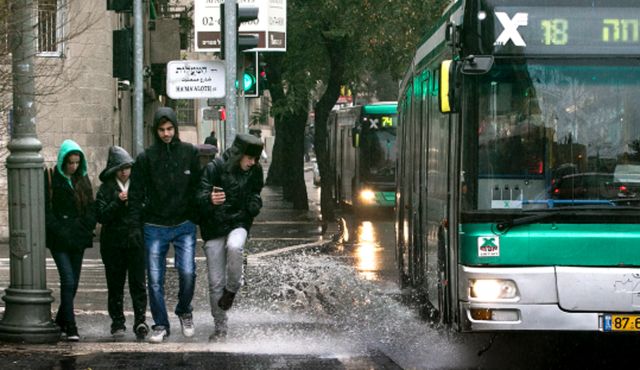
Last week as I rode bus #74 to school, I was sandwiched between a young kippah-wearing soldier with an M16, an elderly hijab-wearing Muslim woman, and a older French man with a lit cigarette in his mouth. This is the true Yerushalayim Shel Ma’alahthe heavenly Jerusalem.

Image

It was recently pointed out to me that the bus routes in Jerusalem aren’t arbitrarily given. They don’t go in any geographical/numerical order. Like the Zohar, they contain a secret code. Hiding in plain sight, they actually have great meaning.

Bus route numbers in Jerusalem correspond to important dates and gematria-related concepts. I take either the 71, 72, 74, or 75 buses to school. And since nothing in Jerusalem is light or easy, this means I actually take the following buses:

  • The “Destruction of the Second Temple” bus (71)
  • The “Siege of Masada” bus (72)
  • The “Fall of Masada” bus (74)

(I’m having trouble tracking down what happened in the year 75 (BCE or CE). It could be either the birth of Hillel, the authorship of Josephus’s The Wars of the Jews, or maybe the Sinai Interim Agreement of 1975 CE… or something entirely different.)

Of course, you could also take the “Babylonian Exile” bus (586), the “Reunification of Jerusalem” bus (67) or the “Chai” bus (18).

This is how we travel in Jerusalem. Nothing in the city is without hidden or deeper meaning. Yehuda Amichai would caution – poetically – against imbuing inanimate objects with meaning at the exclusion of human beings, but there is something to be said about how a culture sanctifies ordinary and everyday things – like riding a crowded bus – with elements from a sacred and holy past.

Are We Irrational Jewish Hypocrites?

Crossposted from The Times of Israel Blog.

In just a few days, an interesting phenomenon will take place. Groups of Jews around the world will mark the destruction of the ancient Temples in Jerusalem with ceremonies of mourning. At the same time, many (most?) of these Jews have absolutely no desire to see the Temples rebuilt. Is this an act theological hypocrisy?

Tisha b’Av has always flummoxed me. I understand the practice of considering the day a memorial for the many additional tragedies which have befallen the Jewish people. To be sure, there’s probably a psychological benefit to the ethos of the Jewish people for an annual opportunity to vent and take thousands of years of weight off of our communal chest.

But memorializing and remembering thousands of years of tragedies is different from engaging in an act of mourning over the loss of an institution which many (most?) do not have any real desire to return to.

Mourning is different from remembering. Mourning implies a manifest sorrow for the loss of something and the desire to have it back. Especially within Judaism, it has specific connotations separate from memory. So while we can remember and appreciate the centrality of the Temple in its time, I would imagine that most non-Orthodox Jews don’t truly mourn on Tisha b’Av. Is it possible to reconcile an outward religious act with a conflicting inward belief?

To be sure, many Jews do mourn the destruction of the Temples and do wish to see the Temple restored. While I disagree with this vision on religious, political, and social grounds, I’m not debating it here. I appreciate this religious belief for what it is, and am in fact somewhat envious of those who hold it. For them, I imagine Tisha b’Av presents no hypocrisy whatsoever, and is a day filled with kavannah (intention) and great liturgical focus.

For most other Jews, we are left with Tisha b’Av as a day of solemn remembrance. But communal historical memory is part and parcel of almost all Jewish holy days. Napoleon and Chaim Weizmann shared a common philosophy when they both observed that Jews have a long memory. It’s no surprise to say that we need to recall our past tragedies.

So what’s going on with Tisha b’Av? What’s taking place in the kishkes of Jews around the world who mark the day?

Rabbi Lewis M. Barth, professor emeritus of midrash at Hebrew Union College-Jewish Institute of Religion, has posited a modern, progressive approach to the day:

Tishah B’Av could be a day that we spend in self-reflection and self-examination regarding (1) the legal, economic, social, moral, and religious issues of our own time, (2) the ways our congregations and communities might measure ourselves and society against our commitments to social justice, and (3) the obligations we have to take responsibility for helping to make this a better world.

Ok, that’s a good start. Great, actually – a perfect model of modern Jewish practice. But it’s no innovation to suggest that as Jews, we need to think about how to better our society. Do we need Tisha b’Av to highlite the importance of tikkun olam?

Even Maimonides has tapped into the quandary of what to do with this day:

There are days when all Israel fasts because of the troubles that happened to them, in order to awaken the hearts and open the pathways of repentance… so that in the memory of these matters we will return to doing the good.

– Mishneh Torah, (Ta’anit 5:1)

The Rambam had a pretty prescient view of modern Jewish life. He cautions us to be unsatisfied with stagnant practices and beliefs solely for the sake of maintaining the status quo. (It should be noted that Maimonides also envisioned the rebuilding of the Temple and the resumption of sacrifices as soon as possible.)

Does that solve the problem of potential hypocrisy in mourning? Is it rational to mourn on Tisha b’Av when we have no desire to see the Beit Hamkidash restored?

Absolutely not. Why mourn something you don’t want back? The reason we mourn things is because we lament their loss, and I would argue that in that light, it’s fairly irrational to mourn the destruction of the Temple. But I also think that’s ok.

When everything is rational; when everything makes sense; when everything is smooth and polished in perfection, we stop thinking. It becomes easier to glide through life without thinking about our actions. When everything is simple and easy and clean, we are robbed of opportunities for kavannah.

Sociologists teach that it is moments of tension that result in opportunities for personal and communal growth. So perhaps Tisha b’Av is the perfect time to engage in a little irrational Judaism. Tisha b’Av can be a time when we embrace the irrationality that exists within a tradition and stretch ourselves a little. Instead of “mourning” and fasting appearing as hypocritical actions, they instead become useful tools for personal and communal growth as Jews.

When we “mourn” the destruction of the Temples, what is hidden behind the irrationality of that mourning is the opportunity to rouse our dormant souls, and awaken ourselves from our otherwise easy day-to-day lives. In that way, we are better able to follow Maimonides’ clarion call and “return to doing good.”

So Tisha b’Av may be a little irrational, but it’s certainly not hypocritical. And while it inextricably rooted in the past, for me (and I think Maimonides, too), it presents a vision directed more towards the present and the future.

That future may or may not include a rebuilt Temple… but I’m not the one who gets to decide that.

The Beatle and the Havdallah Candle

Bonnaroo. Standing in a field surrounded by 90,000 people in the sweltering Tennessee heat, I counted down the minutes. Only 120 left until I was certain that my life was going to change.

Rewind a year to that same field in Tennessee – no doubt surrounded by many of the same people – and I’ve just seen Radiohead perform a set that quite literally knocked the words out of my mouth and left me silent. Trying to describe the experience as we walked back to our campsites, almost everyone was left searching for words that would do justice to the transcendent musical experience we had all shared. I don’t use the word transcendent lightly. It was – quite literally – an experience that elevated me to new heights. After hours, it seemed that most people had settled on beautiful as the only word that accurately reflected the concert. Turning to a friend, I proclaimed “Well now I’m screwed. No concert will ever be better than that.”

I was wrong.

With 120 minutes left until Paul McCartney was set to take the stage, my body tingled in anticipation. I was going to see and hear a Beatle sing to me.

I grew up with The Beatles constantly in my ears. My parents fed my sister and me a regular dose of classic rock, folk, and classical music, but it was The Beatles who were the staple soundtrack of my childhood, enjoying a weekly set every Sunday out of our old-school, wooden stereo speakers.

So when Macca took the stage and played over three hours worth of thirty-eight songs, I knew nothing would ever be the same. Radiohead’s mind-penetrating experimental music be damned, this was the original stuff. You can search elsewhere if you’d like a musical review of the show; this one’s more spiritual.

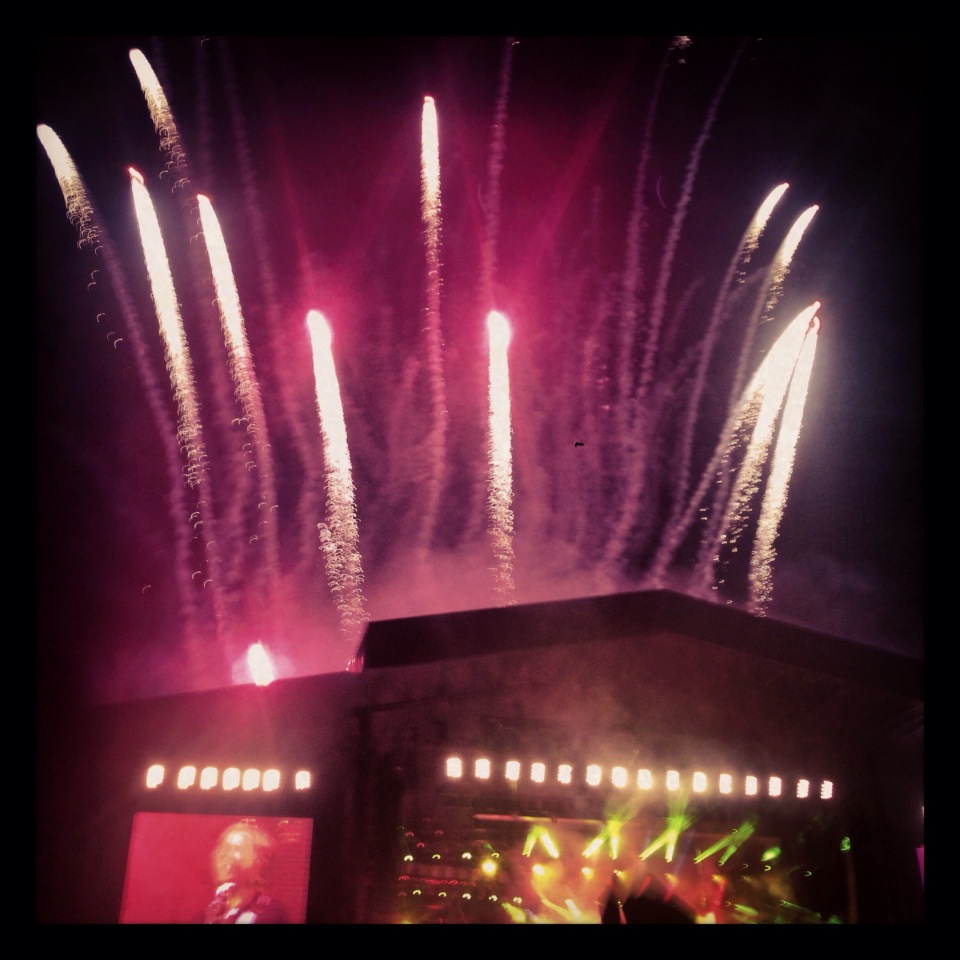
Towards the end of Paul’s sonically blistering (he can still wail on “Helter Skelter”) and emotionally moving (I dare any grown man not to shed tears when he sings “Here Today”) set, as fireworks exploded in the sky above me and 90,000 people sang “Naaaah, na na na na na naaaaah, na na na naaaaah…,” I was completely caught off guard. Like a punch to the soul, my body and brain united in a reaction to the experience. While Radiohead left me speechless looking for adjectives to describe the concert, Paul McCartney completely took over my body, soul, and brain.

Before that day, I can’t recall a moment in my life when I physically felt this way. Some people call these sensations hokey, hippy, or crunchy-granola. Fine. Let it be. All I can vouch for is that something for me changed, as my body reacted to the experience:

  • I felt a complete sense of oneness with the 90,000 people around me. Simultaneously and without contradiction, I also felt as though I wasn’t standing in a crowd of strangers, but was the only one who the music was being played for.
  • I felt pure thankfulness for being in that singular moment. For me, that was directed towards God. For others, it may have been to someone or something else. But the moment for me was one of sincere spirituality that was directly tied to my own personal theology.
  • Feeling the experience coursing through my veins and sending shivers up and down my spine, I questioned why anyone would need the help of drugs, when you can experience a full-body-high naturally. As it happens, it turns out there’s some science behind this. But for me, it went far beyond biology.

At the end of the set – recalling our Radiohead experience a year earlier – I turned to my friend with a bittersweet look on my face and said, “Well, shit. Nothing in life will ever be the same. It’s all downhill from here.”

I was wrong.

Last night, exactly a month after seeing McCartney, my body was hit with the same sensations of oneness and thankfulness.

With sweet music ringing in my ears and a leaping flame in front of my eyes, my body was thrown back to that field in Tennessee. Yet I couldn’t have been further from there. Here, in the center of Jerusalem, as my classmates and I marked the end of Shabbat and the beginning of our formal schooling on our paths to becoming Rabbis, Cantors, and Educators, my body and soul reacted again to an experience in a shocking way. I felt at one with the 40 souls surrounding me, united in the journey ahead of us. I felt a supreme sense of thanks to God for bringing me to this moment in time. Blessed to experience that soul-punching sensation again, the two central foci of my life – music and Judaism – were united in a way that I couldn’t have expected.

That this moment occurred during a Havdallah service is particularly serendipitous, as the ceremony is a multi-sensory experience that – much like Radiohead and McCartney – has the power to cut straight to the human soul. The sight of the flame, the smell of the spices, the sweetness of the wine, and the beauty of the melodies give our body a lingering sensation of the neshama  – the soul – of shabbat.

It seems to me that it’s no surprise that music and Jewish spirituality have the power to biologically affect our bodies in similar ways. Reb Nachman of Bratslav said that the most direct way humans can attach ourselves to God is through music and song. Chassidut teaches that every neshama has its own melody before making the descent into the human world.

Lucky that I get to spend an entire year of spiritual and musical growth with this group of people, I only wish I could say the same for my relationship with Paul McCartney…

Now blogging here and at The Times of Israel

Hey, check out my new blog at The Times of Israel! I’ll continue to blog here, but will also be writing about life in Israel and the rabbinical school journey at the Times of Israel.


There’s No Time Off

There was a brief moment earlier this year during the NHL playoffs between the Montreal Canadiens and the Ottawa Senators that sent rumbles through the hockey-following world, prompting outrage and accusations of classlessness. With a 6-1 lead over the Canadiens and only seconds left in regulation play, the Senators’ coach called for a time-out.

The Canadiens were furious with this seemingly unnecessary move, given that the game was already all but won by the Senators. And yet, the Ottawa players skated off the ice for a few minutes of time away from the action.

Read more at The Times of Israel!

Come and See, Go and tell: Quick thoughts on Bethlehem

I traveled to the West Bank on Friday, as part of a J Street educational visit to Bethlehem. While there, I took a huge amount of photos and notes of what I saw and heard; took in many memories of the people we met with. They will require at least a few posts to unpack.

In the meantime, I wanted to share the words of one of the people we met with who is working to advance coexistence, peace and understanding between populations:

Come and See, Go and Tell

This is what he told us. As best I can tell, it is a variation of a passage from the Christian Bible. And yet, it has a certain Hebrew Bible ring to it – a charge similar to Tzedek, Tzedek, Tirdof; Tze Ulmad; or Na’aseh v’Nishma. While the man who shared this imperative with us was not Jewish, it didn’t limit his ability to share Jewish wisdom. This is significant, as he had every reason to have a tenuous relationship with Jews and Israel – his land just outside of Bethlehem is surrounded by Israeli Jewish settlements, whose settlers have often provoked and antagonized him.

This ability to overcome such interpersonal challenges and move towards understanding and wisdom is surely a quality that will be necessary if we are to finally achieve peace.