Billboard Judaism: Week 1: A (too brief) Review

I’ve had the kippah on for a week. And in that week, some interesting things have happened. Here are two. More to follow.

– A taxi driver in New York launched into a ten-minute, mostly one-sided conversation with me about how his rabbi wanted him to drive him to tashlich, how he loved old Jewish music, and how he wanted to wear a kippah also because he thought it would make him more moral and a better person, but wasn’t sure how to start. I smiled and told him you can really just start, but that it’s not a magic talisman. Or maybe it is.

– At a pub last night, a burly guy in overalls and a tank-top – clearly drunk – sauntered up to me and yelled above the music “Shana Tovah, eh!” This guy would have terrified me normally. I would have avoided him on the street. But now, I was able to smile and say thanks. He yelled “What are you doing here?” I replied, “It my buddy’s birthday!” His response? “OH! Well tell him yom huledet sameach, eh?” He walked off. A brief interaction, but something that would never have happened if it weren’t for the billboard on my head.

To summarize: Wow.

With the kippah, I have attracted attention. And I like it. I feel a little more communal. A little more a part of a whole. What intrigues me – really what delights me – is that the attention I’ve received comes from people who I wouldn’t otherwise have known were Jewish. We’ve had brief connections, been able to smile in something shared that was previously hidden. I’ll unpack this more next week after Yom Kippur.

In keeping with the theme of yom kippur, I will briefly confess that I’m hesitant when walking around some streets of New York, extremely self-conscious about what friends and others think, curious about what goes through peoples’ minds at work, and worried that I’ll be judged any random group of people – Jews or otherwise – walking around.

I still like it. It keeps me on my toes. Keeps me thinking about what being Jewish should mean on a daily basis. And that’s the whole point, eh?

If it’s your thing, have a meaningful fast. G’mar Chatima Tova.

An end to Cardboard Ideology

My body is back in New York. This afternoon, it will be in Toronto. My mind (and my internal body clock) are still in Israel. Along those lines, some thoughts for 5770, courtesy of my favourite journalist-cum-theologian, Bradley Burston:

Perhaps the time has come to ask, as the Talmud asks, “Who is a true hero?” The sage Ben Zoma responds that the true hero is the person who succeeds in conquering the basest of impulses, the worst of human instincts.

In an age of quietly tyrannical political correctness and instant-messaging, the complex heroism of individual Israelis may have no place. Israelis themselves have by and large learned to hide it, to dismiss it, to denigrate it…

…the secret heroism of Israelis is by no means confined to the military. Large numbers of Israelis work tirelessly, heroically, to help pave the way to a common future with the Palestinians. Many Israelis have opened their hearts to helping refugees from foreign genocides. Their stories go largely unnoticed abroad, in no small part because it takes work to make a people long marketed as villains, into flesh and blood fellow humans.

This is the truth. It is politically incorrect in the extreme. It muddies the colors of cardboard ideology and blanket support for one angelic side over the diabolical.

May 5770 be a year of truth, politically incorrectness, and an end to cardboard ideology.

See you next week, when I fire up Billboard Judaism.

Shana Tovah!

Billboard Judaism

Required reading:When a Kippah is not just a Kippah

Background story: It’s 1999. I’m fifteen years old and in grade 10. At the NFTY Northeast Lakes Debates event, I’m dressed in a suit and speaking as eloquently as a geeky fifteen-year-old with a cowlick can. I don’t remember what the topic of the debate was, but I distinctly remember one of my arguments. It went something like this:

The Oxford Dictionary defines religion as ‘a specific fundamental set of beliefs.’ Therefore, religion is based on what you think, not what you do. Judaism is a matter of personal beliefs, not actions…

Oops. I’ve learned a little bit since then. Like not to use dictionaries to support your theological arguments. Fast forward a few years to the 21st century, and I’ve embraced the notion that Jewish religion is based almost entirely on actions, not catechisms. I’m repeatedly struggling with the action of wearing a kippah full-time. It’s quite literally an on-again off-again love affair.

Two years ago, I commented on this blog that if you’re going to wear a kippah (or really any religious article), you need to accept the fact that you’re essentially erecting a giant billboard on top of your head with an arrow pointing down that says “JEW!” Moreover, I argued that if you’re going to put up a billboard, you damn well better know what you’re advertising. While Chabad’s outreach efforts may sometimes make you think otherwise, Judaism isn’t an infomercial – you can’t just spew out as much advertising as possible with the hopes of catching someone’s attention. I would argue that – borrowing some more advertising parlance – if you’re going to wear a kippah 24/7, you need to have a pretty comprehensive marketing plan. You need to know what message lies behind the “JEW!” billboard. Why do you wear a kippah? What does it stand for? What do you hope to gain by wearing it? What does it mean to you to wear it? How does it fit into your life’s mission/vision? What do you say to others who ask you about it? With whom are you casting your lot by wearing it?

And on that note – my struggle has primarily been with how to deal with the Orthodox hegemony vis-a-vis the small, round, knit item. When a non-Orthodox Jew wears a kippah 24/7, it can be like Reebok switching their logo to a swoosh. How can I take part in an important Jewish action without getting lumped in with an ideological group that I have no desire to be conflated with?

Tough questions. Important questions. I don’t have the answer to them yet, but I’ve recently realized that I’m not going to find the answer to “what’s on the billboard?” if I don’t even put the billboard up. In that light, I’m giving myself a new project:

The challenge: Billboard Judaism. This weekend, after leaving shul on the second day of Rosh Hashana, I’m going to keep that kippah slapped on my head. For at least a whole Jewish year. And I’m going to use this blog to record all of the shit that will inevitably roll around in my head by doing so: What I feel like when people look at me. What I think of when walking into a seedy bar. What I think of when I need to remember one more thing when heading out in the morning. And so on and so on…

What I hope to get by the end of this is my Jewish marketing plan. And I hope to be able to distill it down to one simple thing: the answer to the question, “what’s on your Jewish billboard?”

Musings forthcoming…

Dr. Maimonides would be proud

Judaism + Health Care + Politics = an equation you NEVER have to think about in Canada. Down here in Jesusland, it’s an entirely different story. If you haven’t been engrossed in the raging, virulent debate that’s been taking place the past few weeks, consider yourself lucky.

I’m not really going to weigh in, aside from stating that I generally support Obama’s plan. My only hesitation is that I don’t think it goes far enough. But that’s another post.

On the Judaism front, I’m trying to formulate a cogent argument as to why almost all of Jewish thought lines up in support of a socialized health care. For now, I’ll defer to Rabbi David Saperstein who has made the argument that the Talmud itself calls for universal health care:

“by the time of the Talmud 2,000 years ago, [the moral norms of the Torah] had developed into health care systems and rules and requirements to provide adequate health care for all people. Any community that wanted to be considered a moral community had to provide health care, had to provide health care providers. These are not new ideas.”

Old White Jewish Men

Last Friday afternoon, B’nai Brith Canada sent out a news release. They do this often. Stuff happens in the Jewish community, and they send out a news release. Stuff happens in the Christian community, and they send out a news release. Someone farts at York University, and they send out a news release. While the many emails from “JEWISH CANADA” can become annoying at times, I ultimately commend them for remaining diligent in their communication efforts – they do a much better job than many other Jewish organizations.

But. Last Friday’s email was different. The title was:

United Church of Canada Resolutions Insult to Grassroots Canadian Jews

Hmm. Something jumped out at me. Angered me a little. Can you spot it? Moving on, the first sentence in the email read as follows:

B’nai Brith Canada, the voice of the grassroots Canadian Jewish community, was disappointed to learn that resolutions that enable United Church Conferences, Presbyteries, congregations, and community ministries to boycott the Jewish State of Israel, if they so choose, were unanimously passed at the United Church of Canada’s (UCC) 40th General Council.

How about now?

B’nai Brith is many things. They’re a Jewish advocacy organization. They’re an Israel advocacy organization. They’re a human rights advocacy organization. Their newspaper in Canada claims to provide “the real story – and the story behind the story – from a Jewish perspective,” though more often than not, that appears to be code for the Right Wing perspective. I should also say that they run a number of summer camps, and Jewish camping is more than important to me. They are indeed many things, but they are certainly not grassroots.

What is grassroots? For starters, labeling an organization as grassroots implies that there is a movement behind the organization. It implies that a collection of people – the roots – have come together independently to identify as a group with a shared philosophy. What is the B’nai Brith movement? Visit the “About Us” section of the website, and you’ll learn that:

B’nai Brith Canada is the action arm of the Jewish community. We believe in:

1. Reaching out to those in need
2. Fighting antisemitism, racism and bigotry;
3. Promoting human rights and peace throughout the world.

What is B’nai Brith’s philosophy? Their ideology? Their social perspective? These are things we would expect to know about a movement. How many people today will claim that they are part of the B’nai Brith movement?

The term also implies that the movement and its related organizations evolved spontaneously and naturally as a response to some stimulus. B’nai Brith – at least in the USA – certainly had a grassroots origin, with German-Jewish immigrants gathering to do something about the squalor in which Jews were living at the time. But now they have evolved into something beyond this grassroots origin. They do wonderful work, representing their constituents and advocating on behalf of certain Jewish views, but they are far past the days of being a small, grassroots movement. To be sure, they are part and parcel of the Jewish establishment. Meet your friends Federation, the World Zionist Organization, the Jewish Agency, and the State of Israel.

Labeling a group grassroots is also a way to highlight the differences between that group and its accompanying movement, and other organizations governed by more traditional power structures. A quick glance at B’nai Brith and B’nai Brith Canada’s websites is more than enough to show you that they are intimately familiar with “traditional power structures,” as the names and pictures of their leadership look like they came from a Facebook group called “old white Jewish men.”

The labeling of B’nai Brith Canada as grassroots is a curious move by the organization. For one, it is an abrupt change – they’ve never called themselves this before. Last Friday’s email was the first appearance of this adjective. Why, all of a sudden the need to add this term in August 2009? (8.28.09 Update: Turns out they have called their constituency grassroots a few times before. Mostly in press releases.)

I take great issue with this. It’s an attempt to make it look like they aren’t facing declining relevance like the rest of the organizational Jewish world. It’s an attempt to make it look like they don’t have a member base that’s almost entirely made up of people who were born before 1950 (not that there’s anything wrong with people born before the invention of the VW minibus). It’s an attempt to make it look like they attract the same type of people that Obama attracts.

There’s a term for what B’nai Brith is doing. It’s called Astroturfing. And in the political, advertising, and PR world, this is a BIG no-no. By calling themselves grassroots, B’nai Brith Canada is trying to project an image of something it isn’t.

Let me re-iterate: B’nai Brith does many wonderful things, many vital things for the Jewish and broader communities in Canada and the US. But they are not grassroots. To try and present this image is dishonest and unfair.

I’m also left with a few final questions from B’nai Brith’s email of last Friday…

Is there a difference between “grassroots” Canadian Jews and “regular” Canadian Jews? And if so, is the Canadian Jewish community insulted and disappointed en masse, or is just the “grassroots” Jews? And if so, is B’nai Brith really the voice of the entire “grassroots” Canadian community?

This is where B’nai Brith shows their true colours. You can’t just blanket label a group of people as grassroots. At the end of the day, I’m left wondering what B’nai Brith Canada’s “grassroots” movement is all about…


Leonard Cohen’s “psycho-religious” Jewish Journey, Part II

This is a brief follow up to an earlier post about Leonard Cohen‘s incredible Jewish Journey and status in my books as an all around kick-ass dude.

It seems The Forward generally agrees with me that this is a man who should not be ignored. In an article this week, the Jewish paper covered an interesting incident that transpired outside on of his Radio City concerts.

Turns out that instead of a camp-out for tickets, it was the myopic and hypocritical anti-Israel throngs who were making noise outside of Radio City, in an attempt to boycott his concert (did they have tickets? Was it really a boycott if they never had tickets?) and hold a rally, all in a vein attempt to get Cohen to cancel an upcoming concert date in Israel.

I’ve got three things to say:

1. Cohen is exactly the kind of person who these protesters should be encouraging to go to Israel. He is unsatisfied with the status quo, is an ardent supporter of a two-state solution and equal rights, and regularly uses his music to rouse the populous out of dormancy. They should charter a jet and send his ass into Jerusalem right now.

2. Political ponderings aside, the Forward article makes an interesting (and very brief) statement about the differences between Canadian and American Jewry. Check this excerpt out:

Born and raised in Montreal, where he attended Orthodox day schools through high school, Cohen is one of a trio of iconic figures in the city’s intensely ethnic Jewish culture, along with late novelist Mordecai Richler and poet A.M. Klein. All three became towering figures in Canada’s general culture through writings that were deeply suffused with their Jewish experience, in much the same way as American writers such as Philip Roth and Saul Bellow. Unlike the Americans, however, the three Canadians remained deeply engaged with Judaism and the Jewish community throughout their lives.

3. Any article that includes the phrase “a live psychodrama of his psycho-religious career” is worth reading. Check it out.

Help me! And help us all! For the sake of GOOD music!

event_image Will you help me win? Do you want to be a part of music history? Will you help us ALL win?

Click on the picture to head over to the Facebook invite, and click “I’m Attending!” and be a part of the release of this momentous album!

I will be ever-appreciative and may even provide you with cookies in exchange for your assistance (this does not constitute a bribe… I just like cookies)

Many Thanks,
J

At least I don’t have to wear a Sheitel

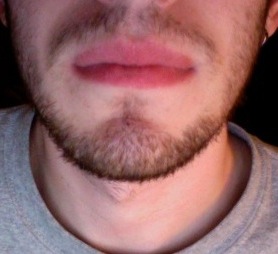
photo-852It’s been two weeks since I’ve shaved. The itchy, irritating, and ever-growing mound of hair protruding from my face is starting to get annoying. Friends at work are asking about it, and I’m starting to get stared at on the subway. That means something in New York. And let me just say at this point that necks should not be allowed to sprout hair; it’s more than a minor inconvenience. It’s weird.
Some have asked if my folicular growth experiment is an homage to my country’s national sport and its related superstitions at this time of year. No, it’s not. I wish it were, though. On Monday night, I was asked by one of my youth groupers if I was just trying to fit in more at a concert I’ll be seeing in June. I laughed.

So the beard growth – for those who aren’t familiar with the Jewish obsession with hair – is one of the customs related to the Counting of the Omer. I’ll say flat out at this point that I’m not mourning any ancient plague or series of destructions. That’s not why I’m growing out the beard. I’m not mourning. I listen to music during these 49 days, and I continute to be a generally happy person. Although there wasn’t a new LOST tonight. That’s a downer.

The reason I let my hair grow is that it is a physical, bodily, intimate symbol of my being a Jew (intentional use of the Present Active Participle form of the verb “to be” ). For 49 days, part of my physical being exudes Jewishness. It’s more than wearing a kippah. It’s something I can’t just take off. Now as a Jewish male, part of my physical being always exudes Jewishness… but I didn’t have any choice regarding whatever was exuded 8 days after I was born. During this time period, I make the active choice to be present with my Judaism.

And what exactly does growing a beard have to do with Judaism? Good question. Like LOST, Judaism has this funny thing with time. 6 days you shall do this, 2 days you shall not do that, these days you shall not eat, these days you shall drink a lot, during these hours you shall do this, at the time when you can see the light of the sun you shall do such and such. And then there’s the custom of not shaving for the 49 days between Pesach and Shavuot.

What’s it really all about?

For whatever reason you choose to buy into, ultimately our ancestors decided that this was a time period when people shouldn’t be engaging in celebratory actions (read: don’t shave, because we don’t shave when we’re mourning, and if we’re not celebrating, then we’re morning). My personal favourite reason for not celebrating at this time is that the period between Pesach and Shavuot comes at the time leading up to the grain harvest in Israel. Our ancestors’ lived a deeply agrarian lifestyle, and their livelyhood and existence was entirely dependent upon the grain harvest. Not wanting to jinx anything or count their sheaves before they hatched, they treaded lightly – avoiding any early celebrations, and going so far as to adopt tribal mourning customs.

So today – in this time – while I can celebrate that Trader Joe’s was not as busy as I thought it would be today and I could harvest me some kickass Mexican avocados, I can also remember that this was not always the case. In fact, for most of our history it was the exact opposite. We were dependent upon the seasons and the rainfall and the dew and the sun and the power of God, and we knew we had to be mindful of that. Time has changed…

Judaism is a religion with practices deeply intertwined with the space-time continuum; a religion that understands that the laws of nature and the laws of physics are part of the laws of halachah. Allow me to wax cliche: “A season is set for everything, a time for every experience under heaven” (Kohelet 3:1). Cliches are cliches for a reason; they’re often truisms, too. While Steven Hawking, Albert Einstein, Abraham Joshua Heschel, and Pete Seeger discover the quirks of time, it’s God who ordains them. And those are some d(D)udes you don’t want to mess with. I may not understand the mechanics of time, or know how to till the soil, but I am able to say “for this time, in this place, I am and will be reminded of the essence of my Jewishness. I can take 49 days and remember that Judaism is a religion that accesses God through the creation of the Earth, and through the experience of time.

That may sound hokey or hippie or maybe even Buddhist. Sure, I’m Jewish and always will be. It’s part of my essence, and I don’t really need to be reminded of that everyday. But it’s nice to physicalize the essential every now and then. How often to we get a chance to internalize and externalize at the same time? As my wise friend, Andy, is currently relaying to me through instant messenger: “We’re too settled in our world of technology, too desensitized. At the end of the day, I think people just need to take a moment to say “damn.'”

I’ve got an itchy beard.

“Damn.”

The Art of the Jewish Journey

This post is cross posted to the URJ KESHER Blog, where I’m also a contributor. They’ve got good stuff there, too.

Leonard Cohen – prolific songwriter, singer, musician, poet, novelist, and philosopher – is a music hero. He’s been inducted into the Rock and Roll Hall of Fame, the Canadian Music Hall of Fame, and the Canadian Songwriters Hall of Fame. He is also a Companion of the Order of Canada – our country’s highest civilian honour. These aren’t mere platitudes bestowed without good reason: his career spans six decades and is unwaveringly progressing; Lou Reed, front-man of The Velvet Underground, has labeled Cohen as being amongst “the highest and most influential echelon of songwriters.” Not bad for an observant Jew from the Montreal suburbs.

In the interest of full disclosure, I admittedly love his music, but what has impresses me most about Cohen is his desire to infuse his connection to Judaism in all that he creates. For him, Judaism isn’t just one sphere of many in his life, it is a ubiquitous reality. Listen to his music, read his poems, or watch him on stage, and it is clear that a Jewish stream flows through all he does. In his music and poetry, Cohen has incorporated Machzor liturgy, Torah ethics, and Tanakh stories (think the opening verse of “Hallelujah”). He also observes Shabbat, even while on tour. Impressive.

And yet, there are those who would accuse him of reneging against his Judaism. You see, Leonard Cohen also embraces a Zen-oriented lifestyle which – for some – is sufficient grounds to expunge him from the Jewish people. Heavy.

In his 2006 “Book of Longing,” Cohen responds to these accusations with poetic eloquence:

Anyone who says
I’m not a Jew
is not a Jew
I’m very sorry
but this is final.

The pen is mightier, indeed.

It seems to me that Leonard Cohen offers a pretty good model of pluralistic Judaism. His argument that a monolithic interpretation of Judaism is inherently antithetical to what Judaism is about is almost Talmudic in its essence. It bears a close resemblance to the oft quoted passage “shiv’im panim laTorah,” that “there are seventy faces to the Torah” (B’midbar Rabbah 13:15). Many Jews could learn from Cohen.

It also seems to me that this man would fit in well at Jewish camp – a place where Judaism isn’t just one sphere of life; isn’t just an item from 10:00-11:00 on the schedule; isn’t confined to the sanctuary or the library. Judaism at our camps is effervescent. Certainly, it manifests itself in different individual ways – music, sports, programming, environmentalism, prayer, and yes, Torah study – but it is most definitely akin to the life Cohen leads: omnipresent and profound.

At our camps, we embrace the notion that there is no monolithic definition of Judaism, or what it means to live a Jewish life. We know that the beauty of Judaism is that every Jew has the ability to find a different, unique face of the Torah and see it in their own way, even while we are all learning and living from the same Book. If Cohen went to a URJ Camp, nobody would tell him he’s not a Jew. Here, we embrace the journey that is Judaism.

So go find some of Leonard’s music or writings, and spend some time with them. Truly, there is a Jewish journey within his art.

Israel vs. The Rest, Part Three

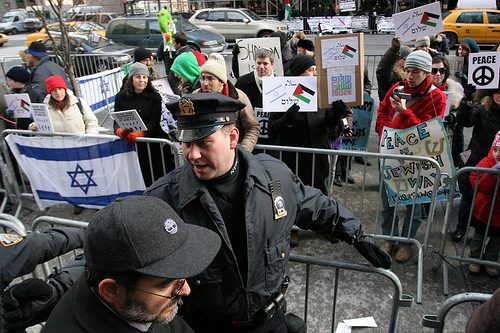
A review of my experiences at yesterday’s pro-peace Rally, this is Part 3 in a series of posts on rallies related to what’s going on the Mideast. Read Part 1 and Part 2.

3188707165_5edebe5bd41
Today, as I think about yesterday’s rallies, I am certain of three things:

1. The frequency of people tagging blogs with “Gaza,” “Israel,” and “Palestine,” has shot through the roof. Needless to say, not everything is newsworthy or even cogent, but at the very least, it does indicate an increased awareness.

2. In my next post, where I focus on what a rally really is, and what it really needs to entail, I’ll argue that the vast majority of the 10,000 people at the pro-Israel “rally” don’t know much about what they are supposedly rallying for. For now, I’ll throw this out there in support of why our protest was a real rally, and the other wasn’t:

No dialogue resulted from the other “rally.” It was just a bunch of guys on a podium shouting platitudes, with a bunch of people cheering. There was no working to bring about change. It was monolithic. Everyone even looked alike, as all were given “tzeva adom” (red alert) hats to wear. The organizer informed the multitudes that these hats were “a symbol that the missiles would stop falling, and the alerts would end.” Right. Hats. Why not take the money that was spent on the hats, and donate it to assist those lives in peril in southern Israel? That’s really advocacy. That’s real activism.

At our rally, there was dialogue (albeit hostile at times), that had the express intent of bringing about a change to the status quo in the Jewish community. We may not have changed people’s point of view, but we made it undeniably clear that this is not a black and white issue. We got attention from a wide variety of media and press, including Radio-Canada, who interviewed me in French when they heard I was Canadian. They all seemed mildly surprised that there could possibly be supporters of a “middle-way.” No surprise, given that much of the media was focused on the giant stage on 42nd Street.

3. Here’s a run-down of the colourful remarks hurled – by Jews – at me and others yesterday:

“You’re leading the way back to Auschwitz!”
“You’ll bring about another 9/11”
“You’re not Jewish! Take off your kippas! You’re not a real Jew!”
“There are no innocent civilians in Gaza!”
“Shame, shame shame!” (Repeat, ad nausea…)

Deeply hurt, I didn’t take any of these slurs personally. They hurt because they’re a stewing indicator of the inability of people to see beyond their own point of view. If there is a solution to the shit, it lies in people who are able to see beyond their limited horizons and outside of their borders.

While I’m not so sure I want to remember everything, I’ll have photos and video posted soon.


Next up, Part Four: Rallying the way to Victory