Men Can be Rabbis?

Crossposted at RJ.org and the NFTY blog

“Who’s that guy?” I asked my mom.

“He’s the rabbi,” she answered. I stared up at my mom, with a blank gaze on my face.

When I was eight years old, my family joined a synagogue for the first time.

Even before then, we always had a fairly strong sense of Jewish identify in our home – celebrating Shabbat every week at my grandparents’ house and observing Rosh Hashanah, Pesach and Chanukah together. From an early age, I was taught how to express the guttural ‘ch’ sound that permeates our people’s speech, and I have fond memories of helping my bubby place all of the items on the seder plate at Pesach, as I checked them off one-by-one in my own coloring book haggadah. The fact that my zaidy had given me The Big Book of Jewish Humor at a young age probably helped, too (or just made matters worse, according to my mother)

So I don’t recall struggling with any heavy questions about Judaism when my parents announced to my sister and I that we’d be joining a shul. They explained all about services, the rabbi, Hebrew school, and the like, and it all seemed fairly straightforward to me.

A few weeks later at the age of eight, I was shipped off to Hebrew school for the first time.

I was that rare breed of kid who actually enjoyed Hebrew school. Maybe it was partly because I was a dork, but I ascribe much of my thirst for Jewish knowledge to the inspirational education I received at the hands of my very first rabbi – Rabbi Nancy Wechsler (now Rabbi Wechsler-Azen of Congregation Beth Shalom in Carmichael, CA).

She was a product of our URJ camps, played guitar and sang with a beautiful voice, and led worship and classes with warmth and inspiration.

She had that rare ability to make eachof her young congregants truly feel that their connection with Judaism and with God was personally meaningful, important, and unique. She saw in each of us a holy spark to be nurtured as we travelled along on our Jewish journeys. On a weekly basis, she made us feel that being Jewish and coming to shul wasn’t a boring and burdensome task, but an exciting and meaningful part of our lives.

So when I looked up at my mom and asked her “Who’s that guy?” you can forgive me for not being even more confused.

I asked my mother that question at the age of nine while sitting in the pews of a synagogue that wasn’t our own. We were attending a friend’s Bar Mitzvah, and their congregation’s rabbi had just ascended the bimah.

He… was a ‘he.’

Men can be rabbis?!” I exclaimed.

I don’t recall my mother’s response, but she assures me that it was a mixture of hilarity, amusement, mild embarrassment, and pride.

I had only known from Rabbi Wechsler, and assumed that all rabbis were women. I wouldn’t understand until years later that my then nine-year-old self had just wandered into one of the great issues of modern Judaism– women in the rabbinate and the role of women in Jewish life.

With the sudden realization that an entire new world was open to me as a male, I started pondering the possibility of a career as a professional Jew. At least that’s the version of events I tell myself today. I’m sure that nine-year-old Jesse just wanted the service to end as quickly as possible so we could get to the oneg.

But there is little doubt in my mind that I wouldn’t have stayed connected to my Judaism through high school, university and beyond, and wouldn’t today be a Jewish Professional if it wasn’t for the foundation Rabbi Wechlser-Azen laid two decades ago.

So while I learned that day that men can indeed be rabbis, I’m pretty thankful that women can be, too.

It’s a cold day in hell; Brian Mulroney is here

Illustration by Anthony Jenkins | The Globe and Mail | 5.2009

“Popularity is meaningless unless you use it to do big and good things for your country and for the people of Canada.”

Wise words.

They’re from Brian Mulroney, speaking about Stephen Harper in an interview with Steve Paikin.

Yes, that Brian Mulroney.

Sure, the guy has a notoriously sleazy political record. But there’s something refreshing about a Tory who is willing to call out Stephen Harper and advance the notion that the government can be a force for greatness.

The Toronto Star’s article on Mulroney today also features off-the-record statements from Conservative staffers who lament that the Tories have few substantive accomplishments to show for their past half-decade in power.

And that’s the direction Canada appears to be heading in… great power wasted. To be sure, Tim Harper (no relation to Stephen) notes that “there is no overarching national debate over defining issues.”

I’m not wishing that Canadian politics become something akin to the political climate in the USA – with its assassinated politicians, gun-toting rallyers, and bombastic showboating – but I do feel a little jealous when confronted with the American desire to engage in national debates over issues of great substance.

That’s something we could learn from our fellow continental citizens.

Whichever candidate says 9/11 the most wins

Remember that episode of Family Guy where Lois runs for mayor? Remember how all she had say was “9/11” to get elected? I kind of felt like I was in the middle of that episode tonight.

Yeah, I went to the Thornhill candidates’ debate tonight. To my American friends who are unfamiliar with the Canadian electoral system, here’s a primer, courtesy of our friends at Wikipedia. The debate was, for the most part, enlightening in its boredom.

I’ll have a more detailed commentary on the debate tomorrow. For now, I’ll just share two things that I’m left thinking this evening:

1. If all community debates are similar to the one I attended, it’s no wonder voter turnout is so low. For the most part (with some notable exceptions), all the candidates did was egotistically tout their qualifications, attack each other, and spit out sound-bites (including Peter Kent using 9/11 as an ominous harbinger of the dangers lapping at Canada’s shores). To her credit, Karen Mock acknowledged that this was a reality of shorter debates and directed people to her and her party’s website for more details.

2. In Thornhill, if you don’t want to see the Conservatives’ Peter Kent elected, I now believe that there’s only one party to vote for, and that is the Liberal Party. I know (painfully) that many point to this as a sign of the unfortunate state of representative democracy in this country. It is sad. It is unfortunate. But the NDP and Green candidates just aren’t up to par. Only the Liberals are in a position to defeat the Conservatives in Thornhill, and this remains true on the Federal level as well.

More to come, tomorrow.

In which I discover that the RCMP may be spying on me… and other interesting blog-related stats

A few interesting things I’ve noticed about my blog today:

1. Oh hey, I wrote my 200th post on this blog the other day and totally forgot about it! If you include my old blog (I used to write at Blogger… it was kind of like living in the projects), I’ve written 290 posts since November 27, 2004. That’s about 45 per year. Not bad, but I wish I had written more and written better.

2. With my recent posts about the Canadian Election (see sidebar for a complete list), my hits from Google have gone way up. Most people have been searching for information on Stephen Harper, particularly related to the Facebook Creeping fiasco. I pretty much tag Stephen Harper and Michael Ignatieff equally, so the fact that people aren’t arriving here by searching for Iggy makes me think a few things:

a) People don’t know anything substantial about Harper’s and the Tories’ (nonexistent) platform and are desperately searching for something. So desperately, that they’ll settle on whatever drek I have to offer.

b) People genuinely like Stephen Harper and are enthusiastically trying to collect as much as possible that’s been written about him. So enthusiastically, that they’ll settle on whatever drek I have to offer.

c) The RCMP is spying on me. No joke – this is a very real possibility.

In any event, that’s where we stand right now with this blog thing.
-J

My friend, my friend she lights the fuse

Israel, my troubled friend, it seems you never miss the opportunity to tug at my heart in opposite directions. This week, you simultaneously shoot yourself in one foot, while strapping on an attractive new Naot sandal on the other.

So you’re going to construct 1,000 new homes in East Jerusalem? I guess that shouldn’t surprise me. It’s certainly in keeping with the way you’ve been acting lately.

Though even when you punch me in the gut like that, with your other hand you lift me up and caress my tear-streamed cheek. Yesterday it was announced that a group of prominent Israelis, including former chiefs of the IDF, Mossad, Shin Bet, are presenting a new straightforward peace plan, based in part on the Arab Peace Initiative. It seems this group of Israelis also intends to rile up support among the Israeli populous and push the government to act upon the plan.

At the end of the day, as complex and confounding as the Israeli/Palestinian situation may be, it can also be remarkably simple, at least for those who want Israel to exist as a respected Jewish Democracy. Watch the creatively produced video above for some insight along those lines.

The new Israeli peace plan could fail. It probably will. But hope is always better than despair. Sentiments too corny? Fair enough. For the emotionally detached, just watch the video above and root your opinion in the fast-approaching demographic reality.

“The middle of the road is only good for horse shit”

That’s funny. And often true. And it makes for a great headline.

More often than not, the status quo sucks, I believe.

It’s been a busy few days on the election-front, so on that note and in lieu of addressing some of the specific campaign promises being made by the parties, I want to stop and do some big-picture wondering.

I’m wondering right now as to what qualifies for middle of the road in Canada these days?

It’s a clichéd truism that governments campaign to the left and right of their party lines, but govern from the centre. To be sure, whatever governing Stephen Harper’s been doing these past few years, it has definitely at times felt to me like we’ve been dragged waist-deep through a pile of horse dung. Or is that Grade-A Canadian moose dung?

If the past five years have been reflective of Canadian centrism, then I want nothing of it.

What can we assume “Middle of the Road Canada” to be? Is there even such a thing? If there is, is it a good thing? Is it something like Middle-America? Turns out the exact middle of Canada is somewhere near Arviat, Nunavut, and my guess is that not a lot of electoral attention is being focused there. So is there an “average” Canadian that the parties are trying to appeal to?

I don’t think so. Sure, polling data suggests certain tactics, phrases, and campaign styles that resonate with the electorate, but that doesn’t mean there’s a singular typical voter.

I don’t think there’s a true “Middle of the Road Canada,” or a “Middle of the Road Canadian.” But there is a status quo and there are those that perpetuate it. I recently lamented that there’s been a dearth of inspiring Canadians as of late. I still think this is so. But we are still the country that gave the world insulin, the telephone, duct tape, walkie-talkies, Standard Time, and Superman, dammit! These things didn’t come about from embracing the status-quo or moseying on down the middle of the road (covered in shit, no less!).

The only “Middle of the Road Canada” that exists, I believe, is one where little gets done, boringness is a virtue, and apathy reigns supreme. Sound familiar? The “Middle of the Road Canadian,” then, is that apathetic voter (or non-voter, as it very well may be) that keeps this status quo churning. Little surprise, then, that the Conservatives are appealing exactly to this sentiment: Harper’s primary fear-based campaign tactic is indeed one of the necessity to “stay the course”.

I’m tired of staying the course. Staying the course means we get to keep on trudging through a pile of steaming horse shit. Staying the course means it’s less likely we’ll come up with the next insulin, the next duct tape, or the next Superman. Props do go to Jim Balsillie for proving the exception when it comes to the next telephone. But it’s a boring phone, and is still number five…

So right now, I’m interesting in finding which political party is doing its best to keep us out of the shit-covered middle of the road:

Harper’s Tories (sans platform) are running a locked-down, uninspiring campaign that has not yet presented any bold new ideas for Canada or Canadians.

Ignatieff’s Liberals, in their platform launched today (more on that, soon), have indeed presented some bold new ideas and governing policies.

And Layton’s NDP (no platform from them yet) are maintaining their own internal status quo.

It’s only a week and a half into the election and I haven’t cast my vote yet. I haven’t yet evaluated the parties on fully equal ground, since it’s only the Libs who have put out a platform (which says something in and of itself).

But if you’re planning your trip down the not so metaphorical Trans-Canada Highway, it’s often beneficial to take a look at a map before you leave. And right now, the Conservatives’ map is just going to get Canadians dragged through a whole load of horse shit again. The NDP’s map – as spiffy and Web 2.0 as it may be – has a tendency to malfunction, and I don’t particularly want to get lost in Biggar, Saskatchewan.

Right now – at this point in the campaign – if you’re judging by how much shit you want to avoid on your journey – which seems as good a reason as any to pass judgement – it’s the Liberals that have the best roadmap for Canada.

I’m not the only one who thinks so. These guys do. And so do these. And hey, even these guys kind of do (but probably not for long).

As an aside, a wise musician friend of mine once laid some wisdom on me with a charge to remember that “what you think is the status quo is always changing.”

So I will not be so myopic as to mark my ballot yet. Lord knows the Grits have been covered in their share of horse shit over the years. But at this point, it is getting easier to see where my big “X” might go.

A valuable and desirable passport

In the winter of 2004 while travelling in Israel, I was robbed in a taxi in Jerusalem. I tell people that it happened at gunpoint, though I can’t be certain because I never got a good look at what the driver was pulling out of the glove compartment before I bailed on the car. But I tell people this because it makes for a more dramatic story. It also has the added effect of making me appear bad-ass, a character trait that I assume isn’t normally assigned to me.

In any event, as I explained in broken Hebrew to the police that night, then again to the Canadian Embassy in Tel Aviv, and repeatedly to friends and family in the days following, I wasn’t entirely sure why I was robbed. I looked like a worn out traveler at the time, certainly with nothing of great monetary value on me.

Except my passport.

If it was clear to the driver that I wasn’t from Israel – and the fact that I asked him to take me to the airport may have had something to do with it – then he likely assumed that I had a foreign passport on me. And that is desirable and valuable.

I share this story now not because I particularly enjoy reminiscing about how I spent four days at the mercy of the Canadian Embassy in Tel Aviv. I don’t. And while we’re at it, the word “Embassy” is a stretch to begin with, since Canada’s pied-a-terre in the Holy Land consists of a few floors of fluorescent-lit office space in a Tel Aviv high-rise.

I share this story as a reminder of the value of a passport – a document with great literal and figurative power and privilege contained in its pages.

So it was with great delight when I read today of the Liberal Party’s proposed higher education initiative, dubbed the “Learning Passport.” In short, the proposed program would automatically give every Canadian high school graduate $1,000 per year to use towards their university or college education. And it would give $1,500 per year to students from low-income families.

That this is the first policy set forth from the new Liberal platform is impressive. That it’s not a partisan vote-buying gimmick is more-so. That in setting it forth, the Liberals have also budgeted the funds for the program is most impressive.

Where would the money come from to fund the Learning Passport? It would be fully funded by rolling back corporate tax cuts that were extended by the Conservatives. Say what you will about fiscal responsibility, but even Harper admits out of one side of his mouth that we’re weathering the global economic crisis well. As the Globe and Mail notes in their editorial:

“Higher education is the single best guarantee of higher earnings and future success; now is a good time, as other countries struggle with crippling debt loads, to make further investments in people…”

What continues to strike me most – beyond the honourable subastance of the program – is the title the Liberals gave the program. It drives strong and meaningful points home: higher education gets you somewhere. Like a passport, it lets you cross otherwise impenetrable barriers. And like carrying the woven bilingual pages in your pocket, a uniquely Canadian pride and privilege comes with attending a Canadian university or college.

For those keeping track, this already addresses one of the items on my personal party platform. So, well done, Grits!

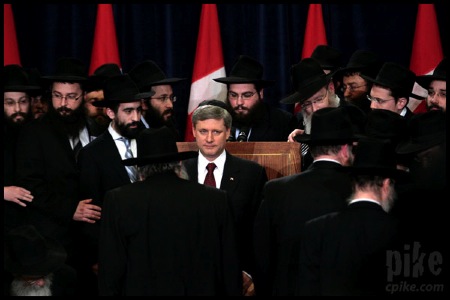
Steven Harper could learn a lot at Yeshiva

To those who, in the upcoming election, might be compelled to base their vote on their religious affiliation:  If you are intent again to use a theo-political issue to trump your vote. (certainly, the Tories have done and are doing everything they can to convince you that this is a good idea), perhaps, first study some Midrash:

“Moses said: ‘I know that the Israelites are malcontents. Therefore, I will audit the entire construction of the Mishkan (Tabernacle)’. He began making an accounting: ‘These are the records of the Mishkan’ and he began reporting everything, the gold, silver and bronze, and the silver of the public census… He continued reckoning each item in the Mishkan in order, but forgot 1575 shekels from which the hooks on the pillars were fashioned, but which were not generally visible. He stood bewildered and said: ‘Now they will lay their hands on me, saying that I took it’, and he went back to recalculate. Immediately, God opened Moses’ eyes and showed him that the silver was used in the hooks on the pillars. He began to reply to them, saying: ‘and 1575 were fashioned into pillar hooks’ and the Israelites were immediately appeased. What enabled this? The fact that he sat and made an accounting…

…But why did he make an accounting?… It is only because he heard the cynics talking behind his back, as it says ‘And when Moshe left…they looked back at Moshe’. What did they say? R. Yitzhak said that people spoke positively. Then others would chime in: ‘Imbecile! He’s the one who controlled the entire enterprise of the Mishkan… gold and silver that were not counted, weighed, or numbered! Wouldn’t you expect that he be rich?’ When Moshe heard this, he said: ‘My word! When the Mishkan is completed, I will make an accounting’, as it says ‘These are the records of the Mishkan.’”

-Midrash Tanchuma, Pekudei 7

What’s going on here?

In short, the Midrash is teaching us that the fiscal cost of the Tabernacle – as a public project funded by the taxes of the Israelites – must be entirely accounted for in an open, transparent, and accessible way.

It’s also teaching us that Moses – as leader of the people – is answerable to the people. Even Moses, who speaks to God face-to-face in a way that no others do, must still face the people.

In a broader sense, it speaks about the virtue of transparency among leaders and the need to be open and answerable to the public.

Stephen Harper could learn a lot from Moses.

An egregious lack of transparency and accountability related to the purchase of military aircraft is exactly what led the Conservatives to be censured for Contempt of Parliament this past week. Of course, anyone with their finger on the pulse of Canadian politics knows that this specific issue is part and parcel of a greater patten of behaviour on part of the Tories; one that paved the way to the landmark ruling by (famed non-partisan) Speaker of the House Peter Milliken.

Certainly if we Jews acknowledge that Moses was expected to be held accountable to the people and to act transparently, we should bestow the same criteria upon Mr. Harper. Certainly if our Midrash teaches us the virtues of un-opaque leadership, we should value that in our national leader as well.

It is challenging for me to view how Harper and the Conservatives can be painted as an honest, transparent, accountable, and open government. Sure, there have been individual instances when they acted reasonable on these grounds. But the story of the Tories – as any learned political observer will tell you – is one of secrecy, opacity, avoidance of responsibility, centralized power, and tight-lipped relations with the Canadian people.

So to the Jews who will likely vote for the Conservatives on the grounds of their supposed dominance of the “support for Israel” (whatever that means) issue: if you value our rabbinic instructions as much as you value the Conservative’s platform (which, remember, didn’t exist when you voted last time…), perhaps you should reconsider the value of your vote.

P.S.: Not convinced that the Tories have a national Jewish-vote buying strategy in place? It isn’t just happening in Thornhill, it’s also taking place down the 401 in Montreal’s Mount-Royal riding.