
This is part 2 in a series of posts on rallies related to what’s going on the Mideast. Part 1 is here.
I had originally intended my second post in this series to be a look at some organizations and people who actually have the guts to get dirty and actively involved in the causes they are supposedly rallying for. I’ll get to that later this weekend. Instead, I need to comment on another “rally” that is taking place right now, as we speak. I received an email yesterday from the World Zionist Organization – a group that I have been an active member of in the past – notifying me of a 24 hour “virtual rally” on Facebook for the citizens of southern Israel. I almost laughed a little. I though to myself “this is either going to be a forum for some pretty harsh vitriol, or it’s going to be a poorly ‘attended,’ with no discernible positive outcome.”
 So I checked in on the “rally” a few minutes ago. There are about 4,000 people “attending,” and about 100 people have posted comments on the wall. I’d say that by Facebook standards, those numbers really aren’t much to be proud of; Zoolander and Hogwarts seem to be more pressing causes. I’m not surprised. What did surprise me was the breakdown of wall posts: about 70% were one line platitudes of Israel’s actions, 5% were anti-Arab rants, and one girl had the courage to post that she was leaving the “rally” because it didn’t offer any constructive purpose, aside from providing a forum for Anti-Arab bashing. And what about the other 25%? Well they thought that they were RSVPing to an actual rally, and posted comments regretting their absence. They didn’t even know it wasn’t a really rally. Sad.
The Facebook “rally” isn’t an ultimately terrible thing. It’s not evil, and if residents of Israel take emotional support from it, then I’m not entirely opposed. But let’s be clear: it’s not a good thing either, and it does have one pretty sinister aspect to it. A “rally” like this lives in the realm of fence-sitting, as it allows people to give vocal (or textual) expression to something they support, but doesn’t channel that support into an active cause. It’s apathy masquerading as passive activism. Like this week’s rally at the Israeli Consulate, the Facebook “rally” doesn’t accomplish much. But at least at the New York rally, people got up on their feet and went somewhere. Here, all people did was click a button online.
To be sure, this was part of the marketing of the “rally” as well. My email informed me that “all you have to do is log in and click ‘attending,'” and that that would be a show of my support and sympathy. Wow! Maybe the WZO and Facebook should partner and create a line of virtual bereavement sympathy cards. They could give Hallmark a run for their money.
What’s saddest of all about the Facebook “rally” is that it was being held on Facebook — arguably the greatest social networking tool humanity currently has at its disposal. Had there been any critical and constructive thinking on the part of the planners, this “event” could have channeled people to get out of their offices, and do something. It could have provided educational resources. It could have been a forum for true dialogue. It could have brought together pragmatists, progressives, and true activists from not only the Jewish, Zionist, and Israeli world, but also the Arab, Palestinian, and “other” world! Instead, a “rally” like this one only furthers the notion that the conflict in the Mideast can be viewed through black and white lenses, or through “Attending” or “Not Attending” mouse clicks. It’s all a virtual folly.
Shabbat Shalom.
Next up:
Part Three – A look at the dictionary definitions of the word “rally” and how that should be your first clue as to how these are not real rallies.
Part Four – A look at some organizations and people who actually have the guts to get dirty and actively involved in the causes they are supposedly rallying for.
Part Five – A review of how I got dirty and active.
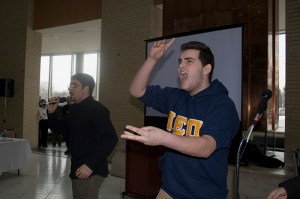 6 years ago, during my first year at York University, it was the height of the second intifada. Both in Israel and on my campus, tensions flared, screaming matches in public places were common, and a war was waged by both sides to win over the compassion of the media. And on some days in Vari Hall, the central court on campus, if you squinted your eyes just enough, you might have actually thought you were in the West Bank. After all, they had bombed out buses, and we had bombed out buses. They had a separation
  This is the story of far too many members of the Jewish community in North America. Switch sides, and it’s the story of far too many members of the Muslim/Arab community in North America. The details really are the same on both sides. People – many of whom have never been to the land they are yelling about – engaged in screaming matches, fueled mostly by pent-up emotions and an unhealthy dose of propaganda from whatever news outlet is telling the story in the way they want to hear it.
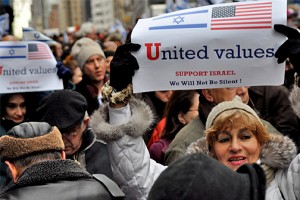 And here, in the centre of the Jewish world outside Israel, I saw more of the same. Yelling and shouting; some of it filled with hatred, some of it filled with passion, but none of it filled with activism. If anybody there thought that their speeches, chanting, and anthem-singing would actually stop Hamas from raining down rockets on Israel, they were sorely misguided. If anybody there thought that their speeches, chanting, and anthem-singing would actually change US policy on Israel, they were sorely misguided. Maybe in a country or city where support for Israel wasn’t natural, a rally such as this could have had a substantive purpose. But this is New York City! The thousands of people crowding Second Avenue weren’t there to accomplish anything other than a giant feat of cheerleading. And unimpressive cheerleading at that – nobody was tossed into the air, there was no marching band, and there were no pompoms.
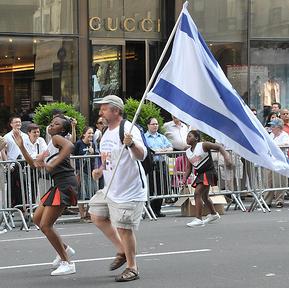 And unfortunately, this isn’t just a Jewish problem. It’s the same on both “sides.” Most of the Western World is content with viewing the conflict in Israel as a football match, because it means they don’t have to get hurt and dirty. They can just dance wildly from the sidelines, cheering and screaming, holding up signs and feeling as though they’re contributing to the welfare of their team.
  Rabbi Jesse Paikin